7 Wonders is a card game about building an ancient city over three Ages. Everyone picks a card at the same time, plays it, and passes the rest, so seven players finish about as fast as three. Its two-player sibling, 7 Wonders Duel, keeps the cities and card colors but trades the passing for a shared layout of cards.
This lesson covers both, from the current Repos Production rulebooks: the 7 Wonders second edition rules and the 7 Wonders Duel rules. Learn the big game first. Duel will feel familiar after.
Prefer to watch first? Watch It Played teaches the rules on video: 7 Wonders (second edition) and 7 Wonders Duel. Watch them, then come back here for the rules in writing and the rest of the course.
7 Wonders: setup
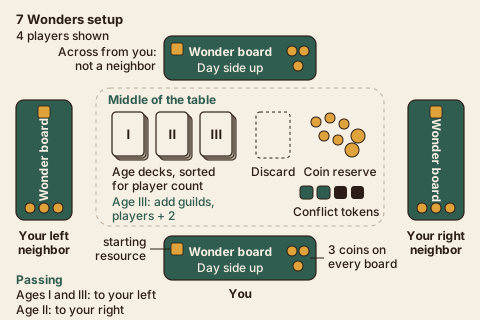
- Each player takes a Wonder board at random and picks a side. The rulebook suggests the Day side for your first few games.
- Put 3 coins worth 1 on your board. That is your Treasure. The other coins and all the Military Conflict tokens go in the middle.
- Each Age card shows a minimum player count (3+, 4+, and so on). Keep only the cards at or below your number of players.
- Take the purple guild cards out of Age III. Draw the number of players plus 2 at random, without looking, and shuffle them back into Age III.
- Shuffle each Age deck and set them face down.
Your neighbors are the players directly to your left and right. You trade with them, fight them, and pass them cards.
7 Wonders: the seven colors
- Brown: common resources (wood, stone, clay, ore).
- Grey: rare resources (glass, papyrus, cloth).
- Blue: victory points.
- Yellow: commerce: coins, cheaper trading, some points.
- Red: shields, your military strength.
- Green: science symbols.
- Purple: guilds, which score by conditions, in Age III only.
7 Wonders: a turn
Each Age, deal 7 cards to every player, then play six turns, everyone at once.
1. Choose. Pick one card and set it face down.
2. Play. Everyone reveals together. Use your card in one of three ways:
- Build it. Pay its cost and place it face up above your Wonder board. You can never build two cards with the same name.
- Build a Wonder stage. Pay the cost printed on your board’s next stage, then tuck the card face down under it. Stages go in order, left to right.
- Sell it. Discard it face down and take 3 coins.
3. Pass. Give the cards you did not choose to your left neighbor in Ages I and III, and to your right neighbor in Age II. The back of every card shows the direction.
On the sixth turn you receive just 2 cards. Play one and discard the other. That discard gives no coins.
7 Wonders: paying for cards
Some cards are free. Some cost 1 coin, paid to the reserve. Most cost resources.
- Your resources come from your starting resource, brown and grey cards, and some yellow cards and Wonder stages. They are never used up: each symbol pays once per turn, every turn.
- Buying. Missing something? Buy it from a neighbor for 2 coins per resource, paid to them. You can buy what their brown cards, grey cards, and starting resource produce, not their yellow cards or Wonder stages. They cannot refuse.
- Chains. From Age II on, some cards show a symbol from an earlier card. If you built that card, the new one is free. Build the Theater in Age I, for example, and the Gardens cost nothing in Age III.
7 Wonders: war at the end of each Age
After the sixth turn, count your shields and compare with each neighbor separately. Higher takes a Victory token: 1 point in Age I, 3 in Age II, 5 in Age III. Lower takes a Defeat token, minus 1. A tie gives no tokens.
7 Wonders: final scoring
After the Age III battles, use the score pad:
- Military: your tokens, added up.
- Treasure: 1 point per full set of 3 coins.
- Wonder stages and blue, yellow, and purple cards: the points each shows or earns.
- Science: for each of the three symbols, square how many you have (1, 4, 9, 16…), then add 7 per set of three different symbols.
Most points wins. Ties go to the most coins, then a shared win.
Duel: setup
- Put the board between you, with the Conflict pawn on the middle space and the 4 Military tokens face up on their spaces.
- Shuffle the Progress tokens and place 5 face up on the board. The rest go back in the box.
- Each player takes 7 coins.
- Choose a first player. Deal 4 Wonders face up: the first player picks 1, the second picks 2, and the first takes the last. Deal 4 more; this time the second player picks first. For a first game, the rulebook gives fixed sets instead (lesson 2 lists them).
- Return 3 cards from each Age deck to the box unseen. Add 3 random guilds to Age III.
Duel: the layout and a turn
Each Age, lay out 20 cards in that Age’s shape, in rows that alternate face up and face down. Age I is a pyramid, 2 cards at the top and 6 at the bottom. Age II is the same shape upside down. Age III is taller. The back of the rulebook shows all three.
On your turn, take one accessible card, one that no other card overlaps. Build it, sell it for 2 coins plus 1 per yellow card you own, or pay one of your Wonders’ costs and tuck the card under it to build that Wonder. Then flip any face-down card you uncovered. Only seven Wonders can be built in a game; when the seventh goes up, the last unbuilt one returns to the box.
You buy missing resources from the bank: 2 coins each, plus 1 for every matching symbol on your opponent’s brown and grey cards. Chains work as in 7 Wonders.
Duel: three ways to win
- Military supremacy. Each shield moves the Conflict pawn one space toward your opponent’s capital. Entering a zone with a Military token costs your opponent 2 or 5 coins. Reach their capital and you win at once.
- Scientific supremacy. Each pair of matching science symbols earns a Progress token. Collect 6 different symbols and you win at once.
- Civilian victory. Otherwise, after Age III, score the pawn’s position (0, 2, 5, or 10), cards, Wonders, Progress tokens, and 1 point per 3 coins. Ties go to the most blue-card points, then a shared win.
Between Ages, the player whose side the pawn is on chooses who starts next. If it sits in the middle, whoever took the last card chooses.
That is both games. If pick-and-pass is new to your table, our explainer on card drafting shows where 7 Wonders sits in that family.
Next lesson
How to Teach 7 Wonders and 7 Wonders Duel
Next, the teach. You get a ten-minute host script for 7 Wonders, a five-minute one for Duel, and a printable teach sheet for both.
Get every lesson by email.
Learn 7 Wonders for the full table and 7 Wonders Duel for two, teach both in minutes, and draft every card like it matters. Free, one short lesson at a time.
Unofficial. Not affiliated with Repos Production or Asmodee. 7 Wonders and 7 Wonders Duel are trademarks of Repos Production.