If Azul just came out of its wrapping paper, you are holding one of the best-looking games on any shelf. The good news: the Azul rules are as tidy as the box. You can learn them tonight and play before the coffee gets cold.
You are a tile artist decorating a palace wall in Portugal. Each round you take colored tiles from shared displays, line them up on your board, and move finished lines onto your wall. Tiles that touch other tiles score more. Tiles you take but cannot use fall on the floor and cost you points.
This lesson follows the current Next Move Games rulebook.
What is in the box?
You get 100 resin tiles, 20 in each of five colors. There are 4 player boards, 9 factory displays, 4 scoring markers, 1 starting player marker, and a cloth bag for the tiles.
Each board has a colored wall on one side for the standard game. The gray side is a variant that the variants lesson covers. Every board has four parts:
- The score track along the top.
- The pattern lines on the left: a staircase of five lines that hold 1, 2, 3, 4, and 5 tiles.
- The wall on the right: a 5 by 5 grid. Each color has one space in every row and every column, so the colors run in diagonals.
- The floor line along the bottom, where unwanted tiles land.
How do you set up?
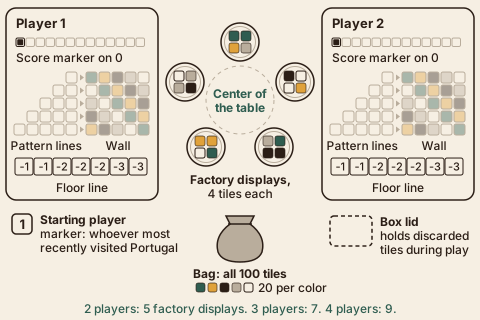
- Each player takes a board, colored wall side up. Everyone uses the same side.
- Put your scoring marker on the 0 space of your score track.
- Set the factory displays in a circle in the middle of the table: 5 for two players, 7 for three, 9 for four.
- Put all 100 tiles in the bag.
- The player who most recently visited Portugal takes the starting player marker. They fill every factory display with exactly 4 tiles drawn from the bag.
Put any unused boards, markers, and displays back in the box.
The factory offer: taking tiles
Each round has three phases: the factory offer, wall-tiling, and preparing the next round. Most of your thinking happens in the first. The starting player puts the starting player marker in the center of the table and takes the first turn. Play goes clockwise. On your turn, you must take tiles in one of two ways:
- From a factory display. Take every tile of one color from one display. Push the rest of that display into the center of the table.
- From the center. Take every tile of one color from the center. If you are the first player this round to take from the center, you also take the starting player marker and put it on the leftmost free space of your floor line.
Then put the tiles you took into one of your pattern lines:
- Fill each line from right to left.
- A pattern line holds one color. If it already has tiles, you can only add more of that color.
- You cannot put a color in a pattern line if that row of your wall already has that color.
- Tiles that do not fit go on your floor line, filling it from left to right. You may also send tiles there on purpose.
The phase ends when every factory display and the center are empty.
Azul scoring rules: tiling the wall
Everyone does this at the same time. Go through your pattern lines from top to bottom. For each complete line, move its rightmost tile to the space of the same color in that row of your wall, and score it right away. Then move the other tiles from that line into the box lid.
Incomplete lines keep their tiles for the next round.
How does a tile score?
- If no tile touches it, above, below, left, or right, it scores 1 point.
- If it touches other tiles, count the tiles connected to it in its row, including itself, and score that many. Then count the tiles connected to it in its column, including itself, and score those too.
A tile that joins a row of 3 and a column of 2 scores 5. The new tile counts in both. A gap breaks the chain, so only tiles in an unbroken line count.
The floor line
After moving your tiles, lose the points printed above each filled floor space: 1, 1, 2, 2, 2, 3, and 3. A full floor costs 14. Your score never drops below 0. Floor tiles go to the box lid.
The starting player marker counts as a floor tile too. Instead of going to the lid, it stays in front of you, because you go first next round. Once your floor line is full, extra fallen tiles go to the lid at no cost.
Preparing the next round
If nobody has completed a horizontal row of 5 on their wall, the player with the starting player marker fills each factory display with 4 tiles again. If the bag runs out, refill it with the tiles from the box lid and keep going.
How does the game end?
The game ends after the wall-tiling phase in which at least one player completes a horizontal row of 5 tiles. Finish that round’s scoring, floor penalties included. Then everyone adds end bonuses:
- 2 points for each complete horizontal row.
- 7 points for each complete vertical column.
- 10 points for each color with all 5 of its tiles on your wall.
Most points wins. If players tie, the one with more complete horizontal rows wins. If that is tied too, the victory is shared.
That is the whole game. Curious how it compares with the other famous pretty-tile game? Our Azul vs Sagrada comparison sets them side by side.
Next lesson
How to Teach Azul
Next, the ten-minute teach. You will get a host script in the order you would say it, so the whole table learns at once.
Get every lesson by email.
Learn Azul, teach it in ten minutes, and turn a pretty tile game into a sharp one, from your first pick to your final bonus. Free, one short lesson at a time.
Unofficial. Not affiliated with Next Move Games, Plan B Games, or Asmodee. Azul is a trademark of Plan B Games.