The Castles of Burgundy is a game about turning dice into a kingdom, one hexagon at a time. You are a duke in 15th century Burgundy. Over 25 rounds you roll two dice, and each die buys one action: take a tile, build a tile, sell goods, or hire workers. By the end, your board is a patchwork of castles, towns, rivers, pastures, and mines, and the best-scoring patchwork wins.
This lesson follows the current Ravensburger and alea edition, the reissue with several expansions in the box. Everything here is the base game. Leave the expansions out for now; the expansions lesson covers them at Level 2.
Prefer to watch first? Watch It Played teaches the rules on video in its Castles of Burgundy How To Play video. Watch it, then come back here for the rules in writing and the rest of the course.
What is in the box?
A double-sided game board (one side for 4 players, the back for 2 or 3), 164 hex tiles in six colors, 42 goods tiles, silver coins, worker chips, bonus tiles, 16 duchy boards, overview boards, and 9 dice: 2 per player plus a white one. Some hex tiles have black backs; they stock the black depot in the center of the board.
Your duchy board has 37 hex spaces grouped into regions of one color. Every space also shows a die number from 1 to 6. That pairing of color and number is the heart of the game.
How do you set up?
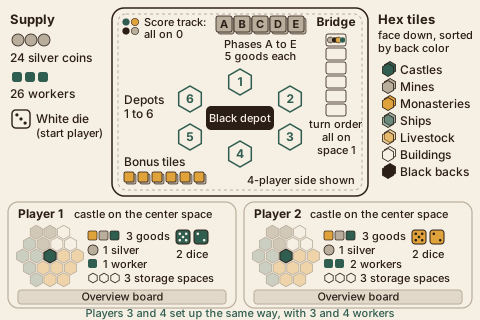
- Lay out the board, 4-player side up for four players, the back for two or three.
- Put the silver, workers, and white die beside it. Sort the hex tiles by back color into face-down piles.
- Shuffle the goods tiles face down. Put a stack of 5 on each phase space, A to E. Keep the other 17 face down.
- Put the bonus tiles on their spaces, large on top of small.
- Everyone takes the same duchy board, number 1 or number 2, and places a castle on the dark green space in the center.
- Each player takes 3 of the 17 spare goods, 1 silver, 2 dice, an overview board, and a victory point tile, and puts a score piece on 0. The remaining goods go back in the box.
- Roll for start player. That player takes 1 worker; going clockwise, the others take 2, 3, and 4.
- Stack the turn order pieces on space 1 of the bridge, start player on top. The start player takes the white die.
How does a phase work?
The game has five phases, A to E, of 5 rounds each. At the start of every phase:
- Clear away any hex tiles left on the board (skip this in phase A). Goods stay where they are.
- Refill the six numbered depots with face-up tiles of the matching colors, and the black depot with black-backed tiles.
- Lay that phase’s 5 goods tiles face up on the round spaces.
What happens in a round?
Everyone rolls their two dice at once, so all can plan. The start player also rolls the white die and moves the next goods tile from the round spaces to the depot with that number. The white die does nothing else.
Players then take turns in bridge order: furthest along first, and top to bottom within a stack. The goods left on the round spaces show how many rounds remain in the phase.
What can a die do?
Each die is one action. Use them in either order, even for the same action twice.
Take a tile. Take one hex tile from the depot matching the die. It goes onto one of the three storage spaces at the bottom left of your board, never straight into your duchy. If storage is full, discard a stored tile first.
Place a tile. Move a stored tile onto an empty space of its own color that shows the die’s number. It must touch a tile already in your duchy. You can take a tile with one die and place it with the other.
Sell goods. Sell every goods tile of the type that matches the die’s number. Flip them face down onto your sold goods space and take 1 silver, plus 2, 3, or 4 points per tile with 2, 3, or 4 players.
Take 2 workers. Any number works.
Two more tools sit outside the dice. Workers: return one to change a die by 1, up or down. A 6 can become a 1, and a 1 a 6. The black depot: once on your turn, at any moment, pay 2 silver to take one of its tiles into storage.
What does each tile do?
- Castle (dark green): take one extra action, as if you had a die showing any number.
- Ship (blue): take all goods from any one depot, then move one space forward on the bridge. You can hold only three colors of goods; the rest stay in the depot.
- Mine (gray): nothing now, then 1 silver at the end of every phase.
- Livestock (light green): score its animals, plus animals of the same type already on that pasture.
- Building (beige): use its power once, right away.
- Monastery (yellow): a lasting power or end-game points, explained in the rulebook.
The eight buildings are the market, carpenter’s workshop, church, warehouse, boarding house, bank, town hall, and watchtower. Your overview board shows what each does. Each type can appear only once per town, a connected area of beige spaces.
How do you score?
You score livestock and goods sales as they happen. You also score two kinds of bonus.
Completed regions. Fill the last space of a region and score twice. First, points for its size: 1 space scores 1, then 3, 6, 10, 15, 21, 28, and 36 for 8 spaces. Second, the phase bonus: 10 in phase A, 8 in B, 6 in C, 4 in D, and 2 in E, for every region, whatever its size.
Filling a color. The first player to fill every space of one color takes that color’s large bonus tile: 5, 6, or 7 points with 2, 3, or 4 players. The second takes the small one: 2, 3, or 4.
How does the game end?
After phase E, everyone scores 1 point per unsold goods tile, 1 per silver, 1 per two workers, plus any monasteries in their duchy that score at the end. Most points wins. A tie goes to the player with the most empty duchy spaces, then to the one furthest back on the bridge.
Dice that reward this much planning feel odd at first. Our piece on luck and skill explains why the pairing works.
Next lesson
How to Teach The Castles of Burgundy
Next, the ten-minute teach. You get a host script in the order you would say it, so the table starts rolling before the rules pile up.
Get every lesson by email.
Learn The Castles of Burgundy, teach it without a long lecture, and make every die count, from your first castle to the final tally. Free, one short lesson at a time.
Unofficial. Not affiliated with Ravensburger or alea. The Castles of Burgundy is a trademark of Ravensburger.