Codenames is a party game for two teams and one grid of words. Each team’s spymaster secretly knows which words are theirs. Everyone else is an operative, trying to find those words from the spymaster’s clues. The catch: a clue is one word and one number, and one word on the table is the assassin.
This lesson follows the current 2025 rulebook from Czech Games Edition for Codenames, designed by Vlaada Chvátil. Older copies may look a little different. Everything below also fits on the one-page Codenames teach sheet.
Prefer to watch first? Watch It Played teaches the rules on video in its Codenames How To Play video. Watch it, then come back here for the rules in writing and the rest of the course.
How do you set up?
In the box: 200 word cards with a word on each side, 8 red and 8 blue agent tiles, a double agent tile (red on one side, blue on the other), 7 innocent bystanders, 1 assassin, 40 key cards, and a card stand.
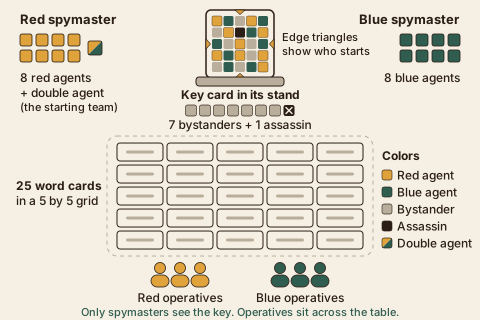
- Make two teams, red and blue, of about equal size, at least two players each.
- Pick spymasters. One per team; everyone else is an operative. Both spymasters sit on one side of the table, across from their own operatives.
- Lay out 25 words at random in a 5 by 5 grid.
- Set the key. The spymasters slide a random key card into the stand between them, either side up. Only they look at it.
- Hand out tiles. Each spymaster takes their team’s 8 agent tiles. The bystanders and the assassin go between them.
- Find the starting team. The triangles on the key card’s edges show who goes first. That team has one extra word to find, so it takes the double agent, flipped to its color.
The key card is a map of the grid. Each square shows what the matching word secretly is: red, blue, innocent bystander, or assassin. The starting team has 9 words to find, the other team 8.
What happens on a turn?
Teams take turns, starting with the team the key shows. Each turn has two parts.
The spymaster gives one clue: exactly one word and one number. The word is about the meaning of some of your team’s words; the number says how many. If SHIP and WAVE are both red, the red spymaster might say “ocean: 2.” A clue for one word is allowed, but linking more is where the fun is. The spymaster says nothing else: no hints, no “this one is a stretch,” no faces.
The operatives guess. They talk it over, then one of them touches a word card. The spymaster covers it with the tile the key shows:
- Your team’s color: you may guess again. That is another guess, not another clue.
- An innocent bystander: your turn ends.
- The other team’s color: your turn ends, and you just found a word for them.
- The assassin: your team loses, right now.
When does a turn end?
A wrong guess ends it. Otherwise your team decides when to stop, within two limits:
- You must make at least one guess every turn.
- The plus one rule. As long as you keep guessing right, you may make one more guess than the clue’s number. “Ocean: 2” allows up to 3 guesses.
The extra guess earns its keep later, picking up a word you missed from an earlier clue. You may guess toward an old clue at any point in a turn, even first.
How do you win?
There are no points. A team wins when all of its words are covered, even if the other team guessed the last one for them. And if the other team touches the assassin, you win.
When the game ends, flip the 25 cards over. The other sides make a fresh grid for the rematch.
What counts as a valid clue?
Clues must stay in the spirit of the game:
- Meaning, not letters or places. “B: 3” for three words starting with B is out. “Seven: 2” for SEAS and DWARF is fine, because it points at meaning.
- No visible words. While a word shows in the grid, you cannot say it or any form of it. With LIGHT uncovered, “lighter” is out.
- No parts of compound words. With FIREWORK uncovered, “fire” and “work” are out.
- English, no accents or tunes. A foreign word counts only if your group would use it in an English sentence, like “taco.”
- Soundalikes only for meaning. “Flour” works for BAKER, not for GARDEN. Groups can agree to allow soundalikes, as the Codenames app does.
- Spell it if asked. Words spelled the same count as one word, so “bat” can point at BASEBALL and CAVE.
- One word, mostly. One-word names and compounds, like “Paris” or “toothbrush,” are fine. Groups can agree to allow abbreviations, full names, and titles. Hyphenated or two-word clues need the other spymaster’s okay.
Not sure? Ask the other spymaster quietly. If they allow it, it is valid. The rulebook’s advice: do not be too strict.
What if a clue breaks the rules?
An invalid clue ends that team’s turn at once, with no guesses, and the other spymaster may cover one of their own team’s words before giving the next clue. The other team can also decide the clue did no harm and allow it. A clue nobody notices until later stands.
Two expert clues for later
The rulebook’s expert rules add two special clues:
- Unlimited. Instead of a number, the spymaster says “unlimited.” The team may keep guessing as long as it guesses right.
- Zero. “Spiders: 0” means “avoid the words about spiders.” It also allows unlimited guesses, with no plus one limit. Ask why you were warned off, then hunt for the words that clue was blocking.
Leave both out of a first game. That is the whole game. To sharpen your clues, our Codenames clue tips cover safe clues, the assassin, and guessing as a team.
Next lesson
How to Teach Codenames and Run a Great First Game
Next, how to run a great first game: choosing spymasters, seating the table, agreeing on clue rules, and keeping the pace up.
Get every lesson by email.
Learn Codenames, teach it in five minutes, then give clues your team gets, guess with nerve, win the endgame, and find more people to play with. Free, one short lesson at a time.
Unofficial. Not affiliated with Czech Games Edition. Codenames is a trademark of Czech Games Edition.