Dune: Imperium is two games in one box. It is a deck builder: everyone starts with the same ten weak cards and buys better ones. It is also a worker placement game: you play those cards to send Agents to a shared board, and a space with an Agent on it is closed to everyone else. If either style is new to you, our explainers on deck building and worker placement cover the basics.
Uprising is the newer, standalone version, played the same way on a reworked board. This lesson teaches the original from the Dune: Imperium rulebook, then flags each place the Uprising rulebook differs. The Uprising lesson in Level 3 covers it in depth. For rulings, Dire Wolf keeps an official FAQ that covers both.
Prefer to watch first? Watch It Played teaches the rules on video: Dune: Imperium and Uprising. Watch them, then come back here for the rules in writing and the rest of the course.
How do you set up?
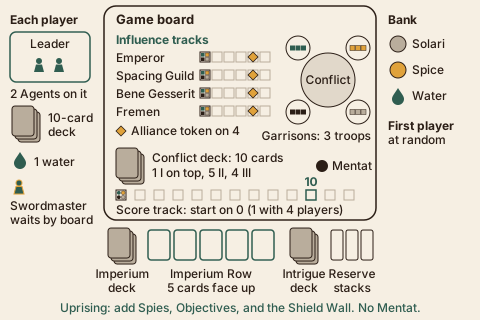
- Lay out the board. Put the Mentat on its space and an Alliance token on each Faction’s Influence track: Emperor, Spacing Guild, Bene Gesserit, and Fremen.
- Build the Conflict deck: the four Conflict III cards on the bottom, five random Conflict II cards on top of them, then one random Conflict I card on top. Ten cards. The rest go back in the box unseen.
- Shuffle the Intrigue deck. Shuffle the Imperium deck and deal five cards face up: the Imperium Row. Put the Reserve cards beside it in their stacks.
- Each player takes a Leader, shuffles a 10-card starting deck, and takes 1 water.
- Put two Agents on your Leader. Your third Agent, the Swordmaster, waits beside the board until you earn it.
- Score marker on 0, or on 1 in a four-player game. Combat marker on 0. One cube at the bottom of each Influence track. Three troops in your garrison, the circle nearest you; the rest are your supply.
- Choose a first player at random.
For a first game, the rulebook suggests Leaders with one icon after their names: Paul Atreides, Glossu “The Beast” Rabban, Earl Memnon Thorvald, or Count Ilban Richese.
Uprising: there is no Mentat, the Shield Wall goes on the board, and each player also takes three Spies. Everyone gets an Objective card, and the one showing the First Player marker decides who starts.
How does a round work?
Each round has five phases: Round start, Player turns, Combat, Makers, and Recall. At round start, reveal the top Conflict card and everyone draws five cards. Then players take turns clockwise, one at a time. Each turn is an Agent turn or your Reveal turn.
The Agent turn
Play one card face up and send an Agent to an empty space whose icon matches one of the card’s Agent icons: a Faction, Landsraad, City, or Spice Trade. One card sends one Agent.
Pay the space’s cost first. If you cannot, you cannot go there. Then take the space’s effect and the card’s Agent box, in any order. A Faction space also moves your cube up one on that Faction’s track.
Troops. A cube icon means recruit a troop from your supply into your garrison. When you send an Agent to a Combat space, the ones with desert art and crossed swords, you may deploy the troops you recruited this turn plus up to two from your garrison into the Conflict. Anywhere else, recruits stay home.
Spice. Hagga Basin, The Great Flat, and Imperial Basin carry a Maker icon. A visit there pays the space’s spice plus any bonus spice piled up on it.
The Reveal turn
When you are out of Agents, or choose to stop, reveal every card left in your hand and use only their Reveal boxes.
- Acquire cards. Spend Persuasion on cards from the Imperium Row or the Reserve. New cards go to your discard pile. Unspent Persuasion is lost.
- Set strength. 2 for each of your troops in the Conflict, plus 1 for each sword you revealed. No troops in the Conflict means 0 strength, however many swords you have.
- Clean up. All your cards in play go to your discard pile. You are done until Combat.
Combat
Starting with the first player, everyone with troops in the Conflict may play Combat Intrigue cards or pass, until all pass in a row. Then the highest strength wins the Conflict and takes the top reward, and second place takes the second reward. The third reward goes to third place only in a four-player game, or a six-player game of Uprising. Players with 0 strength get nothing.
If players tie for first, nobody wins: each tied player takes the second reward. Players tied for second each take the third reward, at any player count. All troops in the Conflict then go back to their owners’ supplies, not their garrisons.
Some Conflicts give control of Arrakeen, Carthag, or Imperial Basin. Your Control marker pays you a small bonus whenever anyone sends an Agent there.
Makers and Recall
Each Maker space with no Agent on it gains 1 bonus spice. Then check for the end. If the game goes on, return the Mentat, recall all Agents, and pass the First Player marker clockwise.
Influence, Alliances, and Intrigue
Reach 2 Influence with a Faction and you gain a Victory Point; fall below 2 and you lose it. Reach 4 and you take the bonus printed on the track. The first player to reach 4 also takes that Faction’s Alliance token and its Victory Point, until someone climbs to a higher space and takes it away.
Intrigue cards stay face down in front of you. Plot Intrigue cards are played on your own turns, Combat Intrigue cards only in Combat, and Endgame Intrigue cards at the end.
How does the game end?
In the Recall phase, if anyone has 10 or more Victory Points, or the Conflict deck is empty, the game ends. Play Endgame Intrigue cards, then the most points wins. Ties go to the most spice, then Solari, then water, then troops in the garrison.
What changes in Uprising?
- Sandworms add 3 strength in the Conflict and double most of the rewards you earn.
- Spies watch board spaces and let you share an occupied space or draw a card.
- Contracts, an optional module, pay you for visiting named spaces.
- Battle icons score a point for each matching pair.
- A new board. There is no Mentat. Deep Desert stands in for The Great Flat, Spice Refinery for Carthag, and new spaces like Imperial Privilege and Espionage join in.
The core of everything above holds. That is the whole game.
Next lesson
How to Teach Dune: Imperium
Next, the ten-minute teach: a host script in the order you would say it, with a printable teach sheet for the table.
Get every lesson by email.
Learn Dune: Imperium and Uprising, teach them in ten minutes, and play every card, Agent, and troop like it matters. Free, one short lesson at a time.
Unofficial. Not affiliated with or endorsed by Dire Wolf, Gale Force Nine, Legendary, or Herbert Properties LLC. Dune and Dune: Imperium are trademarks of their respective owners.