Everdell is a game about building a small woodland city over one year. You send worker critters out to gather twigs, resin, pebbles, and berries. Then you spend those resources to play cards into your city: Critters, the citizens, and Constructions, the buildings. Your city holds 15 cards. When autumn ends, the city worth the most points wins.
This lesson follows the rulebook Starling Games links from its current Standard Edition page. Older printings call two cards Husband and Wife; current printings call them Harvester and Gatherer. If your box differs, that is why.
Prefer to watch first? Watch It Played teaches the rules on video in its Everdell How To Play video. Watch it, then come back here for the rules in writing and the rest of the course.
How do you set up?
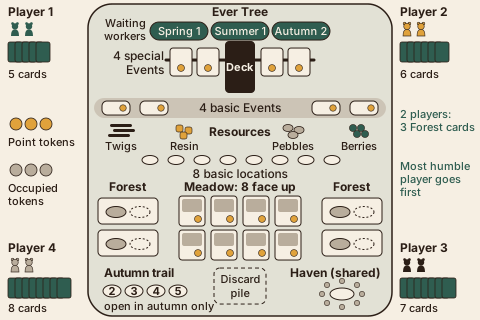
- Put the board in the middle and stand the Ever Tree on the stump at the top.
- Pile the resources along the river. Put the point tokens and occupied tokens beside the board.
- Shuffle the Forest cards and lay them on the forest clearings: 3 cards for two players, 4 for three or four.
- Put the 4 basic Event tiles along the river. Shuffle the special Events, put 4 on the tree’s lower branches, and return the rest to the box.
- Shuffle the main deck, deal 8 cards face up into the Meadow, and put the deck inside the Ever Tree.
- Each player picks a color and takes 2 workers. Deal starting hands: 5 cards to the first player, 6 to the second, 7 to the third, and 8 to the fourth.
- Each player puts their other 4 workers on the tree’s upper branches: 1 on spring, 1 on summer, and 2 on autumn.
The rulebook says the most humble player goes first. Play passes clockwise.
What do you do on your turn?
Exactly one of three things: place a worker, play a card, or prepare for season.
Place a worker
Put a worker on an open paw space and take the reward right away. It stays there until you prepare for the next season. Exclusive spaces hold one worker. Shared spaces, drawn with an open ring, hold any number, even several of yours. The places you can go:
- Basic locations, along the path by the river: 3 twigs; 2 twigs and a card; 2 resin; 1 resin and a card; 2 cards and a point; 1 pebble; 1 berry and a card; or 1 berry.
- Forest cards, which give bigger rewards. Each holds one worker; the second space opens only with four players. Never two of your own workers on one Forest card.
- Destination cards, the red cards, in your own city, or an opponent’s card with an Open sign. Visit theirs and they gain 1 point token from the supply.
- Events. If your city already meets an Event’s requirements, place a worker on it, pay any listed cost, and claim it. Only one player can claim each Event.
- The Haven, a shared space. Discard any number of cards and gain 1 resource of your choice for every 2 cards you discard.
- The autumn trail, the four spaces worth 2, 3, 4, and 5 points that the board marks as open only in autumn. Discard cards equal to the number, and that worker is worth those points at the end. The 2 space is shared; the others are exclusive.
Play a card
Pay the card’s cost to the supply and put it in your city. Play from your hand or from the Meadow; if it came from the Meadow, refill that spot from the deck right away.
- Critters cost berries. Constructions are built mostly from twigs, resin, and pebbles.
- Free Critters. Each Critter names a Construction in its top left corner. If that Construction is in your city, you may play the Critter without paying. Put an occupied token on the Construction. Each Construction can do this once.
- Common and Unique. You can have several copies of a Common card, but only one copy of each Unique card.
- City limit. Your city holds 15 cards. Events you achieve sit beside your city and do not count.
- Hand limit. You can never hold more than 8 cards. If you would draw past 8, stop at 8.
What do the card colors mean?
| Color | Type | When it works |
|---|---|---|
| Tan | Traveler | Once, when you play it |
| Green | Production | When you play it, and again when you prepare for spring and for autumn |
| Red | Destination | When a worker is placed on it |
| Blue | Governance | Bonuses after you play certain cards, or discounts on cards |
| Purple | Prosperity | Its base points plus a bonus at the end of the game |
Prepare for season
When all your workers are out and you cannot or do not want to play a card, prepare for the next season. Bring every worker home, add the new workers waiting on the tree, and take the season’s bonus. That is your whole turn.
- Spring: gain 1 worker, and every green Production card in your city activates.
- Summer: gain 1 worker and draw up to 2 cards from the Meadow. Nothing produces.
- Autumn: gain 2 workers, and your green Production cards activate again.
The game begins in late winter, so you prepare three times in all. Players do not prepare together; each player moves on when they are ready.
How does the game end?
Autumn is the last season. When you cannot or do not want to take more actions, you pass. Nobody can give cards or resources to a player who has passed. The others play on until everyone has passed.
Then add up the base points printed on the cards in your city, your point tokens, purple Prosperity bonuses, your workers on the autumn trail, and your Events. Most points wins. If players tie, the one with the most Events wins, then the one with the most leftover resources.
That is the whole game. If you are deciding whether Everdell suits your group, our Wingspan vs Everdell comparison sets the two side by side.
Next lesson
How to Teach Everdell
Next, the ten-minute teach. You get a host script in the order you would say it, so the whole table learns at once.
Get every lesson by email.
Learn Everdell, teach it in ten minutes, and build a woodland city that keeps paying you back, from your first twig in winter to your last card in autumn. Free, one short lesson at a time.
Unofficial. Not affiliated with Starling Games or Tabletop Tycoon. Everdell is a trademark of Tabletop Tycoon, Inc.