A Lorcana card is a small painting with a lot of game packed around the edges. New players look at the art and the name and miss the rest. The rest is where games are decided: the missing swirl that means a card can never be ink, the Willpower that tells you one challenge will not be enough.
Here is an invented character card, drawn for this course, with every part labeled. It follows the layout of a current Lorcana character, but the character, the text, and the art are all made up.
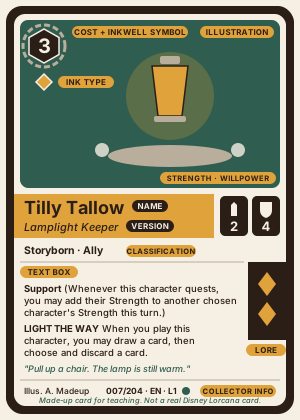
Top left: cost and ink
Cost. The number in the top left is how much ink you must exert to play the card. Tilly costs 3.
The inkwell symbol. A swirl drawn around the cost means the card is inkable: you may put it facedown into your inkwell. No swirl, no ink. This one detail shapes every hand you draw, because a hand full of uninkable cards can leave you stuck with nothing to pay for them.
Ink type. Below the cost is the ink type symbol, and the colored bar behind the name shows the same color. There are six inks: Amber, Amethyst, Emerald, Ruby, Sapphire, and Steel. A constructed deck can use no more than two of them. Some cards carry two ink symbols and count as both.
The middle: who it is
Name and version. The big line is the name. The smaller line under it is the version, because the game has many versions of the same character. Together they make the full name, and the full name is what counts for the 4-copy limit. You can play 4 copies of one version and 4 of another.
When a card says “your characters named” something, it checks only the name, not the version.
Classifications. The line below the name lists categories such as Storyborn, Dreamborn, Floodborn, Hero, Villain, Ally, or Princess. Other cards refer to them, so a Villain deck might reward you for playing Villains. On action, item, and location cards, this line also tells you the card type.
Right side: Strength, Willpower, lore
Strength is how much damage the character deals in a challenge.
Willpower is how much damage it can hold. When its damage equals or passes its Willpower, it is banished. Damage stays from turn to turn, so a character with 4 Willpower and 3 damage is one point away from the discard pile.
Lore is the lore value, shown with lore symbols beside the text box. That is how much lore you gain when this character quests. Tilly brings home 2.
Read these three together. A character with high lore and low Willpower is a great quester and an easy target. A character with high Strength and no lore is a bodyguard or a hunter, not a quester.
The text box: what it does
Keywords are short words with fixed meanings. The reminder text in parentheses explains them on the card. The common ones:
- Bodyguard: may enter play exerted, and opponents who challenge must pick a Bodyguard if they can.
- Challenger +N: gets +N Strength while challenging.
- Evasive: only characters with Evasive can challenge it.
- Rush: can challenge the turn it is played.
- Ward: opponents cannot choose it for their effects, though they can still challenge it.
- Resist +N: damage dealt to it is reduced by N.
- Reckless: cannot quest, and you cannot end your turn while it is ready and can challenge.
- Support: when it quests, you may add its Strength to another character’s this turn.
- Singer N: counts as cost N when singing songs.
- Shift: pay the Shift cost to play it on top of your character with the same name. It keeps that character’s damage and readiness, so a dry character can be shifted and act right away.
Hyperia City added Adventurous, which works like a mirror of Reckless: the character cannot challenge and must quest each turn if able.
Named abilities have a bold name in capitals, like LIGHT THE WAY on our made-up card. The name is just a label; the sentence after it is the rule.
Flavor text is in italics. It does nothing in the game, and it is often the best line on the card.
The bottom line: where it is from
The artist, the collector number, the set number, the language, and the rarity symbol. None of it affects play. It helps you look a card up, sort a binder, or check which set a card came from, which matters for rotation (see the upgrades lesson).
The other three card types
- Actions say Action on the classification line. Play one, do what it says, and discard it.
- Songs say Action and Song. You can pay ink, or exert one of your dry characters with cost at least the song’s cost to sing it for free.
- Items stay in play, and their abilities work the turn you play them.
- Locations are printed sideways. They show a cost, a move cost, Willpower, and sometimes lore, which you gain at the start of each of your turns.
A quick reading habit
When your opponent plays a card, you may look at it; everything in play is public. Read it in this order: cost, Strength, Willpower, lore, then keywords. In five seconds you know how dangerous it is and what it takes to banish it.
Next lesson
How to Teach Disney Lorcana in Ten Minutes
Next, the ten-minute teach: a host script for teaching Lorcana to a friend, a partner, or a kid, plus a printable teach sheet.
Want the course by email?
Pick the right first product, learn how a turn works, read any card, and walk into your first weekly play night and prerelease ready to play. Free, one short lesson at a time.
Unofficial. Not affiliated with or endorsed by Ravensburger or Disney. Disney Lorcana is published by Ravensburger, an official licensee of Disney. Disney characters and names are trademarks of Disney.