Power Grid is a game about running a power company. You buy power plants at auction, buy fuel to run them, and wire cities into your network across a map. Each round, the cities you power pay you, and you spend that money to grow. Whoever powers the most cities when the game ends wins.
This lesson teaches Power Grid Recharged, the current edition. 2F-Spiele publishes it in Germany as Funkenschlag, and Rio Grande Games publishes it in English. If you learned an older edition, a few rules have changed; the first three games lesson lists them.
What is in the box?
A double-sided board with Germany on one side and the USA on the other, 22 wooden houses in each of six colors, coal, oil, garbage, and uranium markers, power plant cards, a Step 3 card, overview cards, money called Elektro, a discount token, and an auction hammer. The rulebook suggests the Germany side for your first game.
How do you set up?
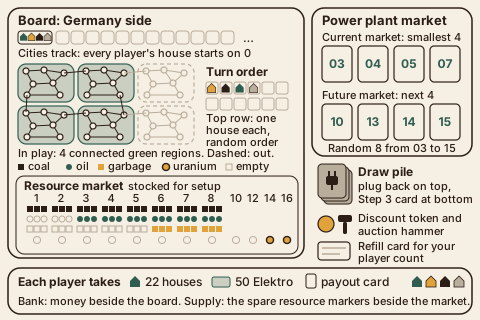
- Choose connected regions of the map to play on: 3 regions with 2 or 3 players, 4 with 4, and 5 with 5 or 6. Cities outside them do not exist this game.
- Each player takes 22 houses, 50 Elektro, and a payout card, and puts one house on 0 of the connected-cities track.
- Put one house from each player on the top row of the turn order track, in random order.
- Stock the resource market: coal on spaces 1 to 8, oil on 3 to 8, garbage on 6 to 8, and uranium on 14 and 16. The rest is the supply. Put the refill card for your player count beside the market.
- Shuffle the plants with plug backs, numbers 03 to 15. Reveal 8 and sort them by number. The 4 smallest are the current market, the next 4 the future market. Set 1 more aside face down.
- Set the Step 3 card aside and shuffle the plants with socket backs. With 2 to 4 players, return a few plants of each back to the box unseen, as the rulebook’s table shows. With 5 or 6, remove none.
- Shuffle all remaining plants into a face-down draw pile. The Step 3 card goes on the bottom, the set-aside plant on top.
What happens in a round?
Five phases. Everyone finishes a phase before the next begins.
Phase 1: Determine player order
The player with the most connected cities goes first. Ties go to whoever owns the highest-numbered plant. In round 1, the order is the random one from setup.
Phase 2: Auction power plants
This phase runs in player order, so the leader starts. First, put the discount token on the smallest plant in the current market. Its minimum bid drops to 1 Elektro.
On your turn, pick one of the 4 current-market plants and open with a bid of at least its number. Never pick from the future market. Bidding goes clockwise: raise or pass, and a player who passes is out of that auction. The last bidder pays the bank and takes the plant. Draw a replacement and re-sort the market.
- Each player can buy only 1 plant per round.
- If you win the plant you picked, the next player without a plant picks. If someone else wins it, you pick again.
- Instead of picking, you may pass. You buy no plant this round.
- In round 1, everyone must buy a plant. Afterward, reset player order by plant number, since nobody has cities yet.
- You can own 3 plants. Buy a fourth and you must scrap one.
- If nobody buys the discounted plant, remove it at the end of the phase and draw a replacement.
Phase 3: Buy resources
Reverse order: last place buys first. Each plant shows which fuel it burns and how many markers it needs. A plant can store up to twice that, and you may only buy what your plants can store. Each marker costs the price printed on its space, so the cheap ones go first. When a resource sells out, nobody can buy more this round.
Phase 4: Build
Reverse order again. Your first house goes in any empty city in the play area for 10 Elektro. After that, each new city must connect to your network. Pay the cheapest route of connection costs from one of your cities, plus the city’s open space: 10, 15, or 20. Move up the cities track for every new city.
Phase 5: Bureaucracy
- Get paid. Choose which plants to run, spend exactly their fuel, and count the cities you power, up to the number you have. Your payout card shows your income. Powering no cities still pays 10 Elektro.
- Refill. Burned fuel goes to the supply. Then add markers from the supply as the refill card shows, filling the most expensive empty spaces first.
- Update the plant market. Put the largest future-market plant under the draw pile and draw a new one.
How do the three steps work?
- Step 1: one house per city.
- Step 2 begins in bureaucracy once someone has 7 cities (6 with 6 players). Remove the smallest current plant once and replace it. Each city now takes a second house, for 15.
- Step 3 begins after the Step 3 card comes out of the draw pile. The market shrinks to 6 plants, and all of them are for sale. Cities take a third house, for 20. In each bureaucracy, the smallest plant now leaves the game and a new one is drawn.
The refill card has a column for each step, so the market refills differently as the game goes on.
How does the game end?
It ends after the build phase in which someone reaches 18 cities with 2 players, 17 with 3 or 4, 15 with 5, or 14 with 6. Then comes one last bureaucracy, and the player who powers the most cities wins. Not the most connected cities: the most powered. Ties go to the most money left.
Each side of the board has one special rule, and two players add a rival company. The player counts and expansions lesson covers both.
Next lesson
How to Teach Power Grid
Next, the ten-minute teach: a host script in the order you would say it, so the whole table learns Power Grid without a rulebook reading.
Get every lesson by email.
Learn Power Grid Recharged, teach it in ten minutes, and win the auctions, fuel fights, and city races that decide who keeps the lights on. Free, one short lesson at a time.
Unofficial. Not affiliated with 2F-Spiele or Rio Grande Games. Power Grid and Funkenschlag are trademarks of their respective owners.