Root is a war game about woodland animals, and it is also four different games sharing one board. The Marquise de Cat builds an industry. The Eyrie Dynasties follow a decree. The Woodland Alliance stirs up a revolt. The Vagabond wanders between them all. Each faction scores in its own way, but they all move, fight, and craft by the same shared rules.
That split is the key to learning Root and to teaching it. This lesson covers them from the current Leder Games books: the Law of Root dated October 13, 2025, and the Learning to Play guide.
Which rulebook should you read?
The base game comes with three booklets, and each has a different job.
- Learning to Play teaches the game in a friendly voice with many pictures. Read this one first.
- The Law of Root is the complete, numbered reference. Keep it nearby for questions.
- Walking Through Root is a scripted two-turn game for four players, read aloud at the table.
When the Learning to Play guide and the Law disagree, follow the Law. When a card disagrees with the Law, follow the card. The Law also asks to be read literally: if a rule does not say something happens, it does not. Leder Games posts the current versions on its resources page, along with a card library and rules errata.
How do you set up?
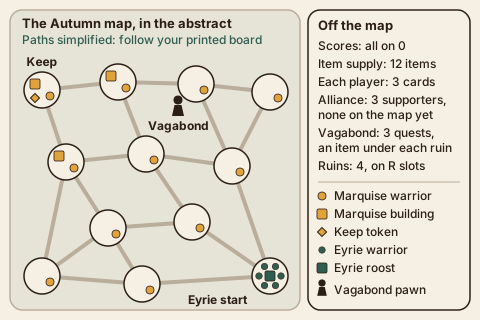
- Choose factions. With four players, use all four. With three, the guide drops the Vagabond. With two, it also drops the Alliance, which leaves Marquise against Eyrie.
- Seat players and pick the first player at random. Put every score marker on 0.
- Deal cards. Shuffle the 54-card shared deck and deal three to each player. With two players, take out the four dominance cards first.
- Place ruins and items. Put the four ruins on the map slots marked R, and the 12 item markers on the item supply at the top of the map.
- Set up factions in order: Marquise, Eyrie, Alliance, Vagabond. The back of each faction board lists its steps.
In short: the Marquise puts her keep in a corner, a warrior in every clearing except the diagonally opposite corner, and a sawmill, a workshop, and a recruiter in or next to the keep’s clearing. The Eyrie place a roost and six warriors in that opposite corner. The Alliance puts nothing on the map; it draws three cards face down as supporters. The Vagabond picks a character, places his pawn in any forest, sets out three quests, and puts one item under each ruin.
What happens on a turn?
Every turn has three phases: Birdsong, Daylight, and Evening. What you do in each depends on your faction, and your faction board lists it step by step. In Evening, most factions draw one card plus any bonuses they have uncovered, then discard down to five.
What does every faction share?
The map. The Woodland is 12 clearings linked by paths. Each clearing has a suit (fox, rabbit, or mouse) and slots that hold buildings. The spaces enclosed by paths are forests, and only the Vagabond goes there.
Rule. You rule a clearing if you have more warriors and buildings there than anyone else. Tokens and the Vagabond pawn do not count. On a tie, nobody rules, unless one of the tied players is the Eyrie.
Moving. Take any number of your warriors from one clearing to an adjacent one. You must rule the clearing you leave, the one you enter, or both.
Battle. Choose a clearing where you have warriors and an enemy has pieces. Roll both dice. The attacker deals hits equal to the higher roll, the defender the lower. Nobody can roll more hits than they have warriors in that clearing. Before the roll, the defender may play an ambush card matching the clearing to deal two hits at once, unless the attacker cancels it with a matching ambush. A defender with no warriors there is defenseless and takes an extra hit. Each hit removes a piece, warriors first.
Cards. The shared deck has four suits: fox, rabbit, mouse, and bird. Birds are wild, so a bird can stand in for any other suit. Most cards can be crafted: activate your crafting pieces in clearings matching the suits in the card’s bottom-left corner, each piece once per turn, and take the effect.
Points anyone can score. Removing an enemy building or token scores 1 point. Crafting an item scores the points on the card (the Eyrie score only 1).
How does each faction win?
The first player to 30 victory points wins immediately. Here is how each base faction gets there.
| Faction | Scores mainly by | Crafts with |
|---|---|---|
| Marquise de Cat | Placing buildings | Workshops |
| Eyrie Dynasties | Roosts on the map, each Evening | Roosts |
| Woodland Alliance | Placing sympathy tokens | Sympathy tokens |
| Vagabond | Aid, quests, exploring ruins, fighting Hostile factions | Hammers |
There is one other path. Four dominance cards let a player with at least 10 points give up their score for a new goal, such as ruling three clearings of one suit at the start of their turn. The guide suggests learning them later, since nobody can use them early.
How do you teach it?
Teach the shared rules to everyone at once, then hand each player their faction board and let it do the rest. The next lesson gives a full host script, both of the guide’s teaching routes, and how to run the first round. Print the Root teach sheet for the middle of the table.
Two players, and later games
With two players, the guide recommends Marquise against Eyrie, with no dominance cards, and two full games: record your scores, swap factions, and add both games together. The back of the board is the Winter map, which shuffles the clearing suits. The guide recommends it only for experienced players, so save it for later.
Next lesson
How to Teach Root
Next, how to teach Root: a host script for the shared rules, the walkthrough route, and how to get four different factions moving in the first round.
Get every lesson by email.
Learn Root and teach it in one sitting, master each base faction, then climb to battle odds, dominance, the faction draft, and your first Root tournament. Free, one short lesson at a time.
Unofficial. Not affiliated with or authorized by Leder Games. Root is a trademark of Leder Games.