Splendor is a race. Everyone starts with nothing. You take gem pieces, spend them on development cards, and every card you buy makes the next one cheaper. Somewhere in the middle of the game, cards start costing almost nothing, nobles come calling, and someone crosses 15 prestige points.
This lesson follows the current rulebook from Space Cowboys, the 10th anniversary edition. Older boxes have different art and call the pieces “tokens,” but the turn works the same way.
Prefer to watch first? Watch It Played teaches the rules on video in its Splendor How To Play video. Watch it, then come back here for the rules in writing and the rest of the course.
What is in the box?
- 40 pieces: 7 each of five gems, Diamond (white), Sapphire (blue), Emerald (green), Ruby (red), and Onyx (black), plus 5 Gold pieces (yellow).
- 90 development cards in three levels: 40 level 1, 30 level 2, and 20 level 3.
- 10 noble tiles.
- 1 First Player marker.
How do you set up?
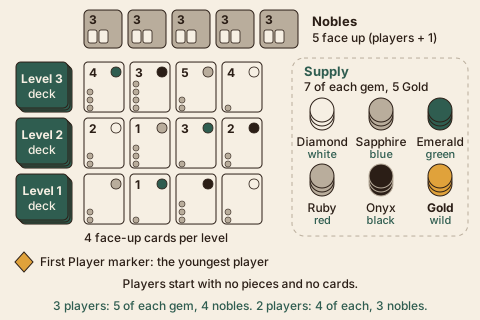
- Shuffle each level of development cards separately. Stack the three decks face down in a column, level 1 at the bottom and level 3 at the top.
- Reveal 4 cards from each deck in a row to its right.
- Shuffle the nobles and reveal one more than the number of players. Line them up above the cards. The rest go back in the box.
- Sort the pieces by color into six stacks everyone can reach. This is the supply.
- The youngest player takes the First Player marker.
With fewer players, the supply shrinks. Gold always stays at 5.
| Players | Each gem color | Nobles |
|---|---|---|
| 4 | 7 | 5 |
| 3 | 5 | 4 |
| 2 | 4 | 3 |
Everyone starts with no pieces and no cards.
How do you read a card?
Each development card shows three things:
- Prestige points in the top left corner. Many level 1 cards have none.
- A bonus gem in the top right corner. It also sets the card’s color.
- The cost down the lower left side, in gems.
Level 1 cards are cheap and worth 0 or 1 point. Level 3 cards are expensive and worth 3 to 5.
What do you do on your turn?
The First Player goes first, then play passes clockwise. On your turn you take exactly one of four actions.
Take 3 gems of different colors. If fewer than three colors are left in the supply, take 2, or even 1. You never take Gold this way.
Take 2 gems of the same color. Only if at least 4 of that color are in the supply before you take them. Never Gold.
Reserve 1 card and take 1 Gold. Take a face-up card, or the top card of any deck without showing it. Keep it in your hand and take a Gold piece. If the Gold is gone, you can still reserve. You can hold at most 3 reserved cards, and you cannot discard them. The only way out of your hand is to buy it.
Buy 1 card. Buy a face-up card or one from your hand. Pay its cost back to the supply. Gold is wild: it stands in for any gem, even a color you already have.
Whenever a face-up card leaves the table, refill its spot from the matching deck. If a deck runs out, that row just gets shorter.
How do bonuses work?
This is the heart of Splendor. Every card you buy sits face up in front of you, and its bonus is a permanent discount of 1 gem of its color on every future purchase.
Own 2 red cards, and a card that costs 3 red costs you 1 red piece. With enough bonuses you can buy a card for nothing at all. There is no change: if your bonuses cover more than the cost, you simply pay nothing.
Sort your cards into columns by color, overlapped so the bonuses and points show. Your pieces stay in view of everyone, and so does your score.
What is the ten-piece limit?
During your turn you can hold any number of pieces. At the end of your turn, if you have more than 10, Gold included, return pieces of your choice to the supply until you have 10.
How do nobles work?
Each noble is worth 3 prestige points and asks for a set of bonuses, such as four cards in each of two colors. At the end of your turn, if your cards meet a noble’s requirement, take that noble. It is not an action. It just happens.
Only card bonuses count. Pieces in front of you do not. You can take only 1 noble per turn. If you qualify for two, choose one and hope the other is still there next turn.
How does the game end?
When a player ends their turn with 15 or more prestige points, the end is triggered. Keep playing until everyone has had the same number of turns. The player to the right of the First Player takes the last turn.
Add up the points on your cards and nobles. Most points wins. If players tie, the one who bought the fewest development cards wins. If that is still tied, they share the victory.
That is all of Splendor. If you want a head start on strategy, our Splendor strategy guide picks up from here, and Levels 1 and 2 of this course go deeper.
Next lesson
How to Teach Splendor
Next, the ten-minute teach. You will get a host script in the order you would say it, so the whole table learns at once.
Get every lesson by email.
Learn Splendor, teach it in ten minutes, and turn a handful of gems into an engine that reaches 15 points first. Free, one short lesson at a time.
Unofficial. Not affiliated with Space Cowboys or Asmodee. Splendor is a trademark of Space Cowboys.