Ticket to Ride is a game about building railroads across North America and quietly hoping nobody takes the one route you need. You collect colored train cards, spend them to claim routes between cities, and try to connect the cities on your secret tickets. It plays 2 to 5 people in about an hour, and the rules fit on a napkin.
This lesson teaches the Ticket to Ride rules from the current Days of Wonder rulebook, the 2025 edition of the original USA map. Older boxes differ in one setup detail, noted below.
Prefer to watch first? Watch It Played teaches the rules on video in its Ticket to Ride How To Play video. Watch it, then come back here for the rules in writing and the rest of the course.
What is in the box?
A board with a map of North America and a scoring track around its edge. Trains and a scoring marker in 5 colors; each player uses exactly 45 trains, and the extras are spares. 110 train cards: 12 in each of 8 route colors, plus 14 locomotives, which are wild. 33 tickets, each naming two cities and a point value. And 1 longest path bonus card.
How do you set up?
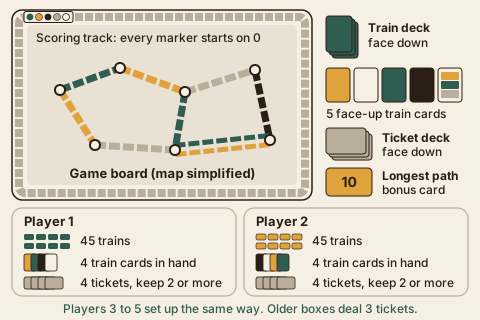
- Put the board in the middle of the table.
- Each player takes 45 trains and the scoring marker of one color, and puts the marker on 0 on the scoring track.
- Shuffle the train cards and deal 4 to each player.
- Turn the top 5 cards of the deck face up beside the board. If 3 or more of them are locomotives, discard all 5 and turn up 5 new ones.
- Put the longest path bonus card face up next to the board.
- Shuffle the tickets and deal 4 to each player. Look at yours in secret and keep at least 2. Shuffle the returned tickets together and put them on the bottom of the ticket deck.
- Choose a first player any way you like. Play goes clockwise.
Older boxes: rulebooks printed before 2025 deal 3 tickets at the start, and you keep at least 2. Use the rule in your box.
What do the Ticket to Ride rules let you do on a turn?
Exactly one of three things.
1. Draw train cards. Take 2 cards. Each one can come from the face-up row or blind from the top of the deck. When you take a face-up card, replace it from the deck right away, before you choose your second.
If you want a face-up locomotive, it must be your first card, and it is your whole draw: you take no second card. A locomotive you happen to draw blind from the deck counts as a normal single card, so you still draw your second.
Any time 3 of the 5 face-up cards are locomotives, discard all 5 and turn up 5 new ones. There is no hand limit. When the deck runs out, shuffle the discards into a new deck.
2. Claim a route. A route is the row of colored spaces between two neighboring cities. Play as many cards as the route has spaces, all matching its color, then put one of your trains on each space and discard the cards. Locomotives can stand in for any color.
- Gray routes take a set of any one color.
- You claim one whole route per turn, never part of one.
- Your route does not have to connect to your other trains.
- Double routes are two parallel routes between the same cities. One player can never claim both. With 2 or 3 players, only one of the pair can be claimed at all; the other closes for the rest of the game.
3. Draw tickets. Take 3 tickets from the top of the deck and keep at least 1. Return the rest to the bottom of the deck. You can never return a ticket you already held. Keep all tickets secret until the end.
How do routes score?
You score a route the moment you claim it:
| Route length (trains) | 1 | 2 | 3 | 4 | 5 | 6 |
|---|---|---|---|---|---|---|
| Points | 1 | 2 | 4 | 7 | 10 | 15 |
Longer routes pay far more per train. That curve drives most of the strategy in later lessons.
How do tickets work?
A ticket is complete when a continuous line of your own trains links its two cities, through any number of other cities. Other players’ trains never count.
At the end, each completed ticket adds its value to your score, and each one you kept but did not complete subtracts it. That is the risk in every ticket you hold.
How does the game end?
When a player ends their turn with 0, 1, or 2 trains left, every player, including that one, gets one final turn. Then the game ends.
Final scoring goes in this order:
- Recount route points if you want to check the track.
- Reveal tickets. Add each completed one and subtract each failed one.
- The player with the longest continuous path of their own trains takes the bonus card and scores 10 points. A path can loop and pass through a city more than once, but no single train counts twice. Tied players all score the 10.
Most points wins. If players tie, the one who completed the most tickets wins. If they are still tied, the one holding the longest path card wins. Otherwise they share the victory.
That is the whole game. To see how it compares with the other classic first game, read our Catan vs Ticket to Ride comparison.
Next lesson
How to Teach Ticket to Ride
Next, the ten-minute teach. You will get a host script in the order you would say it, so the whole table learns at once.
Get every lesson by email.
Learn Ticket to Ride, teach it in ten minutes, and know when to draw, when to claim, and when a ticket is worth the risk. Free, one short lesson at a time.
Unofficial. Not affiliated with Days of Wonder or Asmodee. Ticket to Ride is a trademark of Days of Wonder.