Wingspan is a game about attracting birds to your wildlife preserves. Each bird you play lands in one of three habitats on your player mat: forest, grassland, or wetland. Each habitat is also an action. The more birds live in a row, the more that action gives you, and their powers fire along with it. That growing machine is why people call Wingspan an engine builder.
This lesson teaches the Wingspan rules from the current Stonemaier Games rulebook, its appendix, and the official Rules and FAQ page. Expansions wait until the expansions lesson at Level 2.
Prefer to watch first? Watch It Played teaches the rules on video in its Wingspan How To Play video. Watch it, then come back here for the rules in writing and the rest of the course.
What is in the box?
The box holds 170 bird cards, 26 bonus cards, 8 double-sided goal tiles, a goal board, 5 player mats, 40 action cubes in 5 colors, food tokens, eggs, 5 food dice, a birdfeeder dice tower, a bird tray, and a small Automa deck for solo play. Current printings add a Swift-Start pack for learning games: 10 birds with grey corners and 4 player guides.
How do you set up?
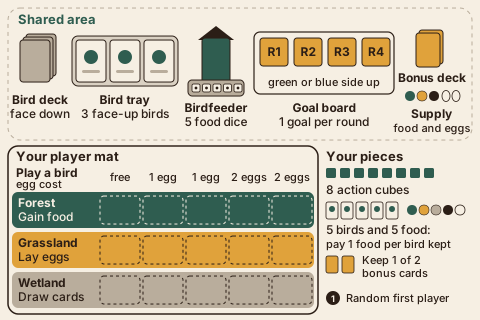
For the table:
- Shuffle the bird cards into a deck. Put 3 face up on the bird tray.
- Put the food tokens and eggs in a supply everyone can reach.
- Toss the 5 food dice into the birdfeeder.
- Place the goal board. The green side ranks players and is the default. The blue side scores 1 point per item and suits new players.
- Place 1 goal tile, random side up, on each of the 4 round spaces.
- Shuffle the bonus cards into a deck.
For each player:
- Take a player mat, 8 action cubes of one color, 2 random bonus cards, 5 random birds, and 5 food tokens, one of each type.
- Keep up to 5 birds. For each bird you keep, discard 1 food.
- Keep 1 of your 2 bonus cards. You may look at both while choosing birds.
- Choose a random first player and give them the first-player token.
What do the Wingspan rules let you do on a turn?
Place 1 action cube on your mat and take 1 of 4 actions. Repeating an action is allowed.
Play a bird. Place your cube above the column where the bird will go, then pay two costs:
- Eggs, set by the column. Column 1 is free. Columns 2 and 3 cost 1 egg. Columns 4 and 5 cost 2 eggs. Take the eggs off any of your birds.
- Food, shown in the bird’s top left corner. A wild icon means any food. A crossed-out circle means free. When playing a bird, any 2 food tokens can count as any 1.
Put the bird in the leftmost open space of a habitat shown on its card. Each habitat holds 5 birds. If it has a “when played” power, use it now. Playing a bird is the only action that does not activate a row.
Gain food (forest). Place your cube on the leftmost exposed slot of your forest row. For each die shown, take a die from the birdfeeder, one at a time, and gain the matching food token. The face showing two foods gives you one of them, not both. Some slots let you discard a bird card for 1 extra food.
Lay eggs (grassland). Use the leftmost exposed grassland slot and lay that many eggs on your birds, in any mix, up to each bird’s egg limit. Extra eggs are lost. Some slots let you pay 1 food for 1 more egg.
Draw cards (wetland). Use the leftmost exposed wetland slot and draw that many birds from the face-up tray, the deck, or both. There is no hand limit. Some slots let you discard 1 egg for 1 more card. The tray refills at the end of your turn.
After those three actions, slide your cube right to left along the row. Each bird with a brown “when activated” power that it passes may use it. Every power is optional. Your turn ends when the cube reaches the left edge.
How does the birdfeeder work?
Dice you take stay out until the feeder is refilled. If it is empty, toss all 5 dice back in. If every die left shows the same face, even a single die, you may toss all 5 back in before you gain food. The two-food face counts as its own face.
What do the bird powers mean?
- Brown, “when activated”: fires each time you use that bird’s row.
- White, “when played”: fires once, when you play the bird.
- Pink, “once between turns”: fires on another player’s turn, at most once between your own turns.
To cache is to put a food token on a bird. You cannot spend it, and it is 1 point at the end. To tuck is to slide a card under a bird, also 1 point. A predator is a bird that hunts.
What happens at the end of a round?
When everyone has placed all their cubes:
- Take your cubes off your mat.
- Score the round’s goal. Each player marks their result with one cube on the goal board, even a 0.
- Replace the 3 birds on the tray.
- Pass the first-player token clockwise.
That goal cube stays on the board, so you get 8 turns in round 1, 7 in round 2, 6 in round 3, and 5 in round 4.
On the green side, players rank by the item the goal counts. Round 1 pays 4, 1, and 0 points for 1st to 3rd, rising each round to 7, 4, and 3 in round 4. You need at least 1 of the item to score. On the blue side, score 1 point per item, up to 5.
How does the game end?
The game ends after round 4. Score the points printed on your birds, your bonus card, and your goals, plus 1 point for each egg, cached food token, and tucked card. Most points wins. On a tie, the most unused food tokens wins. Still tied, you share the victory.
That is the whole game. For the big picture of why your twentieth turn feels so different from your third, read our explainer on engine building games.
Next lesson
How to Teach Wingspan
Next, the ten-minute teach. You will get a host script in the order you would say it, so the whole table learns at once.
Get every lesson by email.
Learn Wingspan, teach it in ten minutes, and build a bird engine that keeps scoring, from your first five cards to your last egg. Free, one short lesson at a time.
Unofficial. Not affiliated with Stonemaier Games. This is not an official Stonemaier product. Wingspan is a trademark of Stonemaier LLC.