Ark Nova is a game about building a modern zoo. You build enclosures, bring in animals, hire sponsors, and support conservation projects around the world. Every turn is one action, chosen from a row of five cards. Underneath the animals sits a clever timing puzzle.
It is also a big game. Board Game Arena rates it 4 out of 5 for complexity, and it is the one heavy pick on our best board games of 2026 list. Our board game weight explainer shows what that means at the table. This lesson covers the rules in the current English rulebook, version 2.0, then ends with a short script for teaching them.
How do you set up?
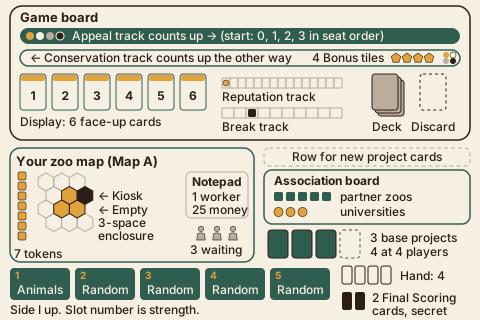
For the table:
- Put the game board in the middle. Place the Break token on the start space for your player count.
- Shuffle the 9 Bonus tiles and put 4 at random on the blank yellow Bonus spaces. The rest go back in the box.
- Shuffle the Zoo cards into a deck and deal 6 face down to the display.
- Set the association board beside the game board. Put 1 partner zoo of each continent and 1 university of each kind on it.
- Shuffle the base conservation projects and lay 3 face up below the association board, or 4 with four players. With two players, the rulebook has you block some spaces with tokens of an unused color.
- Shuffle the Final Scoring cards and pick a random start player.
For each player:
- Take a Map A zoo map. Place an empty 3-space enclosure next to the printed kiosk.
- Put your action cards side I up below the map: Animals in slot 1, the other four at random.
- Put your appeal, conservation, and reputation counters on the first spaces. On appeal, the start player begins at 0, the next player at 1, then 2 and 3.
- Place 7 player tokens on the left edge of your map. Put 1 association worker on the notepad and lay the other 3 below it. Take 25 money.
- Draw 2 Final Scoring cards and keep them secret.
- Draw 8 Zoo cards and keep 4. When everyone has chosen, flip the display face up.
How does a turn work?
Pick one of your five action cards. The number above its slot, 1 to 5, is the action’s strength. You may spend X-tokens to add 1 strength each. Do the action. Then move that card to slot 1, and slide the cards that were to its left one slot to the right.
So an action you skip never loses strength and usually climbs, and an action you just used drops to its weakest. That one rule is the heart of the game.
If no action helps, you may take 1 X-token instead, still moving a card to slot 1. You can hold at most 5 X-tokens.
What do the five actions do?
On side I:
- Cards. Move the Break token 2 spaces. Then draw from the deck: at strength 1, draw 1 and discard 1; at 2, draw 1; at 3, draw 2 and discard 1; at 4, draw 2; at 5, draw 3 and discard 1. At strength 5 you may instead snap: take any 1 card from the display.
- Build. Build one building with a size up to the strength, paying 2 money per space. It must touch a building you already have. Your first one must cover a border space of your map. Kiosks earn money; a pavilion gives 1 appeal right away.
- Animals. At strength 2 to 4, play 1 animal from your hand; at 5, play 2. Strength 1 does nothing. Meet the card’s conditions, pay its cost, and fill an empty enclosure that is big enough, with any water or rock it needs next to it. Flip the enclosure and gain the animal’s appeal.
- Association. Send a worker to one task whose value is no higher than the strength: 2 reputation (value 2), a partner zoo (3), a university (4), or a conservation project (5). If one of your workers is already on that task, it takes two.
- Sponsors. Play 1 sponsor card with a level no higher than the strength, or move the Break token that many spaces and take that much money.
During the game you can flip some action cards to a stronger side II. The action cards lesson covers which ones to choose.
What happens at a break?
When the Break token reaches the end of its track, the player who got it there takes 1 X-token, finishes their turn, and then everyone takes a break:
- Discard down to 3 cards in hand (5 with one of the universities).
- Your association workers come home. The partner zoos and universities refill.
- The two display cards in folders 1 and 2 are discarded, and the display slides down and refills.
- Take income: the money printed next to your appeal, plus your kiosk income, plus any income icons you have.
How does the game end?
Appeal comes mostly from animals. Conservation points come mostly from supporting projects, which takes an Association action at strength 5. Spaces 2, 5, and 8 on the Conservation track pay bonuses, and when any player first reaches 10, everyone discards one of their two Final Scoring cards.
The two tracks run toward each other. When your appeal and conservation counters land in the same scoring area or pass each other, the end is triggered. If it happens at the end of your turn, everyone else takes one more turn. If it happens during a break, everyone does.
Then score your Final Scoring card and any sponsor cards with end-game effects. Your final score is your appeal plus the small number printed on your conservation space. Highest wins. Ties go to whoever supported the most conservation projects.
Teaching it in about fifteen minutes
Ark Nova has a lot of icons, so teach the rhythm and let the cards explain themselves. Print the Ark Nova teach sheet and set it in the middle.
- The goal. “Two tracks run toward each other. Animals push appeal one way; projects push conservation the other. When they cross, the game ends.”
- The row. Do one real turn. “This card is in slot 4, so strength 4. I use it, it goes back to slot 1, and everything to its left slides up.”
- The five actions. One sentence each, pointing at each card. Animals first; it is the fun part.
- Money. “You get paid at breaks, and more appeal means more money.”
Leave out the side II details, donations, releasing animals, and the Final Scoring card discard. Teach each when it comes up. The next lesson turns this into a full host script, and our guide on how to teach any board game covers the general method.
Next lesson
How to Teach Ark Nova
Next, the fifteen-minute teach: a host script in the order you say it, what to leave out, and how to coach a first game.
Get every lesson by email.
Learn Ark Nova and teach it in one sitting, then play every action card, project, and sponsor with the crossing of the two tracks in mind. Free, one short lesson at a time.
Unofficial. Not affiliated with Feuerland Spiele or Capstone Games. Ark Nova is a trademark of Feuerland Spiele.