Brass: Birmingham puts you in the West Midlands during the Industrial Revolution, from 1770 to 1870. You build industries, link towns with canals and then railways, and score victory points (VPs). Roxley calls it the number 1 game on BoardGameGeek. Each rule counts.
This lesson follows the current Roxley rulebook and doubles as your teaching script. The teach sheet puts the whole game on one printed page.
Prefer to watch first? Watch It Played teaches the rules on video in its Brass: Birmingham How To Play video. Watch it, then come back here for the rules in writing and the rest of the course.
What is in the box?
Brass: Birmingham plays 2 to 4, ages 14 and up, in 60 to 120 minutes by Roxley’s count. You get a board with a day side and a night side (use either), player mats, industry and link tiles in four colors, merchant tiles, cards, coal, iron, beer, and money.
How do you set up?
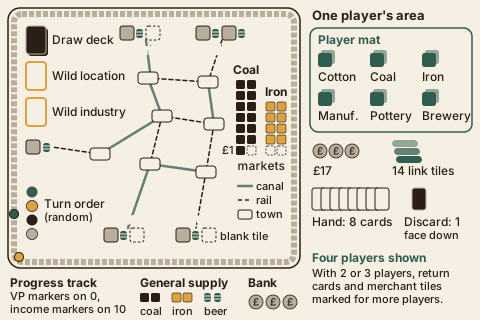
The board:
- With fewer than 4 players, return every card and merchant tile marked for more players than you have.
- Put the 4 Wild Location and 4 Wild Industry cards face up in their spaces. Shuffle the rest into the draw deck.
- Shuffle the merchant tiles. Place one face up on each merchant space marked for your player count, and a beer barrel beside each one that is not blank.
- Fill the coal market, leaving one £1 space empty. Fill the iron market, leaving both £1 spaces empty. The rest forms the supply and the bank.
Each player:
- Take a player mat, a character tile, £17, and the 14 link tiles and 45 industry tiles of your color. Stack the industry tiles on their slots, black top half face down.
- Put your VP marker on 0 and your income marker on the 10 space of the progress track. That space is income level 0.
- Draw 8 cards. Place 1 more face down as the start of your discard pile.
Then shuffle everyone’s character tiles onto the turn order track in random order. With 2 or 3 players, some location cards leave the deck, but you can still build in those towns.
What do you do on your turn?
Take 2 actions, or just 1 in the first round of the Canal Era. Discard 1 card per action; only Build cares which card. You may repeat an action. Then refill your hand to 8.
- Build. Place the lowest-level tile of one industry from your mat, pay its cost, and use any coal or iron it needs. A location card builds in that town, even outside your network. An industry card builds that industry in a town in your network. Use a space showing only that industry if one is free.
- Network. Place a link next to a town in your network. In the Canal Era, 1 canal for £3. In the Rail Era, 1 rail for £5, or 2 rails for £15 plus 1 beer from a brewery. Every rail also uses 1 coal.
- Develop. Remove 1 or 2 tiles from your mat, lowest level first, paying 1 iron each, to reach higher levels.
- Sell. Flip your cotton mills, manufacturers, and potteries that are connected to a merchant who buys those goods, paying the beer each tile shows.
- Loan. Take £30 and move your income marker back 3 income levels.
- Scout. Discard 2 more cards and take 1 Wild Location and 1 Wild Industry card. You cannot scout while holding a wild card.
You may pass, but still discard a card for each skipped action.
Your network is every town that holds one of your industry tiles or touches one of your links. Two towns are connected if a chain of links, anyone’s, joins them. You may have only 1 industry tile per town in the Canal Era, but several in the Rail Era.
Where do coal, iron, and beer come from?
The coal, iron, and beer lesson in this level covers these in full.
- Coal must be connected to where it is used. Take it free from the closest connected coal mine that still has coal, whoever owns it. If none is connected, buy from the coal market, cheapest first, which needs a connection to a merchant location. An empty market still sells coal at £8.
- Iron never needs a connection. Take it free from any iron works with iron on it. If none has any, buy from the iron market, cheapest first, or at £6 if it is empty.
- Beer comes from your own breweries, with no connection needed, or from a rival’s brewery that is connected to where the beer is used. When you sell, you may also use the barrel beside the merchant you sell to, and take that merchant’s bonus.
Coal mines, iron works, and breweries flip when their last cube or barrel is used, even on another player’s turn. Whenever a tile flips, its owner moves their income marker up the number of spaces shown on it.
What happens at the end of a round?
Money you spend goes on your character tile. When everyone has played, whoever spent least goes first next round, and ties keep their order. Return that money to the bank. Then everyone collects their income level in money, or pays it if it is negative. The game’s last round pays no income.
How do the eras end?
An era ends when all hands are empty: after 8 rounds with 4 players, 9 with 3, or 10 with 2. Score in this order:
- Links. Each of your links scores 1 VP per link icon in the two locations it touches. Flipped industry tiles show link icons, whoever owns them, and each merchant location shows 2. Links leave the board as they score.
- Industries. Each flipped industry tile scores the VPs in its corner. Unflipped tiles score nothing.
After the Canal Era only, remove all level 1 tiles from the board, refill any empty merchant beer spaces, shuffle every discard pile into a new deck, and draw 8 cards each. Level 2 and higher tiles stay, so they can score again.
After the Rail Era, most VPs wins. Ties go to higher income, then more money.
How do you teach it?
With the teach sheet in the middle of the table, the short version runs in this order: the goal, a turn, Build, Network, and Sell, then Develop, Loan, and Scout, then coal, iron, and beer with one example each, and last the end of an era. Before the first turn, repeat three rules that are easy to miss: one tile per town in the Canal Era, coal needs a connection while iron never does, and merchant beer only works when you sell to that merchant.
The teaching lesson turns this into a full host script. For a gentler start, the rulebook has an introductory game: play the Canal Era only, then add 1 VP per £4 you hold (up to 15), VPs equal to your income level, and the VPs of your level 2 and higher tiles a second time.
Our guide to board game weight explains what a heavy game like this means for planning the night, and how to teach a board game covers habits that shorten any teach.
Next lesson
How to Teach Brass: Birmingham
Next, the teach itself: a host script in the order you would say it, with one example for each resource and the Rail Era rules saved for the break.
Get every lesson by email.
Learn and teach Brass: Birmingham in one sitting, then master both eras, coal, iron, and beer, loans, and the link math that decides close games. Free, one short lesson at a time.
Unofficial. Not affiliated with Roxley Games. Brass: Birmingham is a trademark of Roxley Games.