Carcassonne is a game about building a map together and arguing, politely, over who gets credit for it. Each turn you add one square tile to a growing landscape of roads, cities, monasteries, and fields. Then you decide whether to put one of your wooden followers, the meeples, on what you just placed. Finish a feature with your meeple on it and you score.
This lesson covers the Carcassonne rules in the current Z-Man Games edition. The rulebook splits them in two: the core rules, then a supplemental sheet for farmers and two small extras. We follow the same order.
Prefer to watch first? Watch It Played teaches the rules on video in its Carcassonne How To Play video. Watch it, then come back here for the rules in writing and the rest of the course.
What is in the box?
You get a start tile with a dark back, a large set of land tiles with normal backs, a scoreboard, and meeples in five colors, 8 per color. There are also 12 river tiles (dark backs) and 5 abbots. Those are the two mini-expansions included in the box. Leave both out for now; the expansions lesson in Level 1 covers them.
How do you set up?
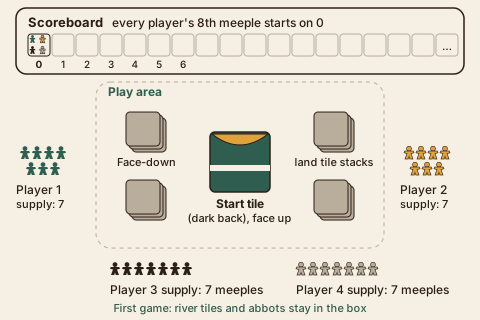
- Put the start tile face up in the middle of the table.
- Shuffle the land tiles and make several face-down stacks, so everyone can reach at least one.
- Each player picks a color and takes 7 meeples as their supply.
- Put your 8th meeple on the 0 space of the scoreboard. It tracks your score.
- The youngest player goes first. Play passes clockwise.
What do the Carcassonne rules let you do on a turn?
Three steps, always in this order.
1. Place a land tile. Draw exactly one tile and place it face up next to a tile already on the table. Every edge must continue the landscape: road meets road, city meets city, field meets field. In the rare case your tile fits nowhere, return it to the box and draw another.
2. Place a meeple (optional). You may put one meeple from your supply on the tile you just placed. Where you put it decides its job:
- On a road, it is a traveler.
- On a city, it is a knight.
- On a monastery, it is a monk.
The one big limit: you cannot place a meeple on a feature that already has a meeple anywhere on it, even far away on another tile.
3. Score points. If your tile completed a road, city, or monastery, score it now. That includes features with other players’ meeples on them. After scoring, the meeples on that feature go back to their owners’ supplies.
When is a feature complete, and what is it worth?
| Feature | Complete when | Points |
|---|---|---|
| Road | Both ends are closed, by a village, a city, a monastery, or a loop | 1 per tile |
| City | Fully surrounded by walls, with no gaps inside | 2 per tile, plus 2 per coat of arms |
| Monastery | All 8 surrounding spaces have tiles | 9 (itself plus the 8 around it) |
Move your score meeple one space per point.
Because you place a meeple before you score, you can put a meeple on a tile that finishes a feature, score it, and take the meeple straight back.
What if two players share a feature?
You cannot join a feature that is already claimed. But two separate features can grow into one. If you start your own city next door and a later tile connects the two, both knights are now in the same city.
When a shared feature scores, the player with the most meeples on it scores the full points. If players tie for most, every tied player scores the full points. Nobody splits anything.
How do farmers work?
Once your group has a game or two behind it, add farmers from the supplemental rules. The green land on the tiles is fields. Roads, cities, and other features divide fields from each other.
- Place a meeple lying down on a field. It is now a farmer.
- The same claim rule applies: no farmer on a field that already has one.
- Farmers score only at the end of the game. They never come back to your supply.
- At the end, each field is worth 3 points for every completed city it touches.
- The player with the most farmers on a field scores it. Ties all score in full.
One city can touch several fields, so it can pay out to several farmers.
How does the game end?
The game ends when the last land tile has been placed. Then everyone scores the meeples still on the board:
- Road: 1 point per tile, same as during the game.
- City: 1 point per tile and 1 per coat of arms, half its completed value.
- Monastery: 1 point, plus 1 per surrounding tile.
- Field: 3 points per completed city it touches.
Most points wins. A tie means shared victory.
That is the whole game. If someone at your table asks “what’s a meeple?”, our short history of the meeple has the answer.
Next lesson
How to Teach Carcassonne
Next, the ten-minute teach. You will get a host script in the order you would say it, so the whole table learns at once.
Get every lesson by email.
Learn Carcassonne, teach it in ten minutes, and play every tile and meeple like it matters, farmers included. Free, one short lesson at a time.
Unofficial. Not affiliated with Hans im Glück or Z-Man Games. Carcassonne is a trademark of Hans im Glück.