Cascadia is a calm game about building your own corner of the Pacific Northwest. Each player grows a landscape of hexagon habitat tiles and fills it with wildlife: bears, elk, salmon, hawks, and foxes. Nobody attacks anybody. The tension lives in the shared display in the middle of the table, where every pick you make changes what the next player can take.
It won the Spiel des Jahres in 2022, and part of its charm is easy to feel: on almost every turn, you can do something useful, even when the offer is not quite what you wanted. This lesson covers the rules in the current English rulebook from AEG and Flatout Games, in the same order the rulebook uses.
What is in the box?
- 85 habitat tiles, 25 of them keystone tiles. There are five habitats: mountains, forests, prairies, wetlands, and rivers.
- 5 starter habitat tiles, each a cluster of three hexes.
- 100 wildlife tokens, 20 each of bear, elk, salmon, hawk, and fox, plus a cloth bag to draw them from.
- 21 wildlife scoring cards: 4 for each animal, lettered A to D, and 1 card for the Family and Intermediate variants.
- 25 nature tokens, shaped like Douglas fir cones, and a scorepad.
How do you set up?
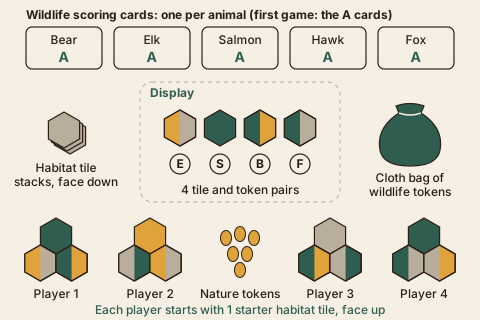
- Put all the wildlife tokens in the bag and shake it.
- Count out habitat tiles at random, without looking: 43 for two players, 63 for three, 83 for four. That is 20 per player, plus 3. Shuffle them into face-down stacks and put the rest back in the box.
- Pick one scoring card at random for each of the five animals and lay them where everyone can read them. For a first game, the rulebook recommends the A cards.
- Deal each player one starter habitat tile at random, face up in front of them.
- Reveal 4 habitat tiles in the middle of the table. Draw 4 wildlife tokens from the bag and pair one with each tile, in order. This is the display.
- Put the nature tokens within reach. The player who most recently saw one of the game’s animals goes first, or pick someone at random.
Your starter tile, and everything you add to it, is your environment.
What do you do on your turn?
Two steps, then a refill.
1. Pick a tile and a token. Before anything else, check the display for overpopulation:
- If all four tokens show the same animal, they are wiped automatically. Set them aside, draw four new tokens one at a time to pair with the tiles, then return the old ones to the bag. This can happen more than once in a turn.
- If exactly three match, you may choose to wipe those three the same way. You can only do this once per turn.
Then take one pair as it sits: a tile and the token beside it.
2. Place both in your environment, in either order.
- The tile must touch at least one side of a tile already in your environment. You cannot place it on top of another tile, and you never move tiles once placed. Habitats do not have to match, though matching edges matter for scoring.
- The token goes on any tile in your environment that shows that animal and has no token yet. It does not have to be the tile you just took. Each tile holds at most one token, ever.
- If no tile can take the token, or you would rather not place it, return it to the bag.
Refill. Replace the tile from the top of any face-down stack and the token from the bag. Do not slide the other pairs; just fill the gap. Play passes clockwise.
What are nature tokens for?
A keystone tile shows a single habitat and a single animal. When you place that animal’s token on it, take a nature token.
Before you pick, you may spend a nature token to do one of two things:
- take any one tile and any one token from the display, even if they are not paired, or
- wipe any number of tokens and replace them from the bag.
There is no limit to how many you spend in a turn. Any you keep are worth 1 point each at the end.
How does the game end?
If, at the end of a turn, the stacks are empty and the tile just taken cannot be replaced, the game ends right away. Because of the tile count, everyone plays exactly 20 turns.
How does scoring work?
The scorepad has four parts.
- Wildlife. Score each animal by its card. Bears score in groups, elk in lines or shapes, salmon in runs, hawks spread apart, and foxes by their neighbors. The openings lesson at Level 2 walks through all twenty cards.
- Habitat corridors. For each habitat, find your largest connected group of it. Tiles connect when matching habitat edges touch. Score 1 point per tile in that group.
- Corridor bonuses. Compare each habitat’s largest group around the table.
- Three or four players: the largest gets 3 points and the second largest 1. If two tie for largest, each gets 2 and nobody scores second. If three or four tie for largest, each gets 1. A tie for second scores nothing.
- Two players: the largest gets 2 points, and a tie gives 1 each.
- Nature tokens. 1 point for each one you did not spend.
Most points wins. If players tie, the one with the most nature tokens wins. If they are still tied, they share the victory.
That is the whole game. If you are deciding between Cascadia and its leafy shelf neighbors, our comparison of Wingspan, Everdell, and Cascadia lays out how they differ.
Next lesson
How to Teach Cascadia
Next, the ten-minute teach. You will get a host script in the order you would say it, so the whole table learns at once.
Get every lesson by email.
Learn Cascadia, teach it in ten minutes, and read every scoring card like a trail map, from your first draft to your last corridor. Free, one short lesson at a time.
Unofficial. Not affiliated with Flatout Games or AEG. Cascadia is a trademark of Flatout Games.