The Ludarium Academy · Full course · Free
Wild Corridors
An unofficial Cascadia course
Learn Cascadia, teach it in ten minutes, and read every scoring card like a trail map, from your first draft to your last corridor.
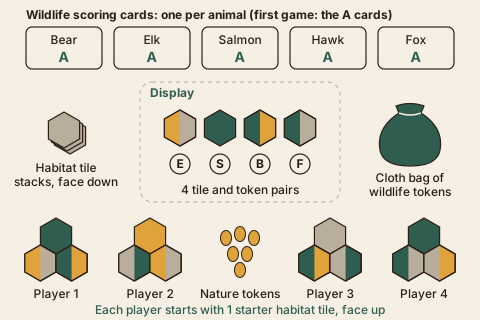 Free printable teach sheetSetup, a turn, scoring, and three tips on one page.
Five levels, 18 lessons
Start with lesson oneLevel 0 · Learn to play
Wanderer
After this level: Set up, teach, and score a full game of Cascadia by hand, overpopulation and nature tokens included, without opening the rulebook.
Level 1 · Beginner
Hiker
After this level: Commit to two or three animals, build around the A cards, and grow corridors big enough to win habitat bonuses.
Level 2 · Intermediate
Tracker
After this level: Read any set of the twenty scoring cards, lay tiles as landing spots, work the shared display, and spend nature tokens only when they pay.
Level 3 · Advanced
Naturalist
After this level: Put odds on the bag, beat the hardest cards, win the two-player duel, and clear the solo scenarios that set the bar at 100.
Level 4 · Tournament ready
Ranger
After this level: Play a two-hour, four-player tournament game to win your table, and plan a path to the World Boardgaming Championships.
- 1How to Play Cascadia
- 2How to Teach Cascadia
- 3How to Score a Game of Cascadia by Hand
- 4Your First Three Games of Cascadia
- 5Cascadia A Cards Strategy: Building Around Your First Set
- 6Cascadia Habitat Corridors: Growing the Big Forest
- 7Cascadia Player Counts, Variants, and Expansions
- 8Cascadia Openings: Reading All Twenty Scoring Cards
- 9Cascadia Tile Placement: Building Landing Spots
- 10The Cascadia Midgame: Drafting, Tempo, and the Bag
- 11Cascadia Nature Tokens: Earn Them, Hold Them, Spend Them
- 12Cascadia Endgame and Scoring Math
- 13Cascadia Odds: Reading the Wildlife Bag
- 14The Hardest Cascadia Scoring Cards and How to Beat Them
- 15Two-Player Cascadia Strategy: Winning the Duel
- 16Cascadia Solo Strategy: Scenarios and Scores of 100
- 17Competitive Cascadia: Tournaments and Online Play
- 18Cascadia Tournament Strategy and a Six-Week Practice Plan
Every lesson is free to read here, any time. Sign up and they also arrive by email, one at a time, so the course keeps you learning between game nights.
Who it is for
- New players who want the rules clear before the first token leaves the bag.
- Hosts who teach Cascadia to family, friends, or a quiet new group.
- Players who love the puzzle but keep finishing a few points short.
- Anyone curious about the B, C, and D cards, solo scenarios, and tournaments.
- Players
- 1 to 4
- Play time
- About 45 minutes
- Ages
- Ages 10 and up
- Rules as of
- Cascadia rulebook, English edition (AEG and Flatout Games, rules copyright 2021), current PDF from AEG's Cascadia page
Questions
How many turns do you get in Cascadia?
Exactly 20. Setup uses 20 habitat tiles per player plus 3, and the game ends at the end of the turn when a taken tile cannot be replaced from the stacks. Solo games also last 20 turns.
What happens when three or four wildlife tokens in Cascadia are the same?
If all four tokens in the display show the same animal, they are wiped automatically and replaced from the bag, and that can happen more than once in a turn. If exactly three match, the active player may wipe those three, once per turn.
What do nature tokens do in Cascadia?
You take one when you place a wildlife token on a keystone tile showing that animal. Before you pick, you may spend one to take any tile with any token, or to wipe and replace any number of tokens. Each one you keep is worth 1 point at the end.
Do habitat tiles have to match when you place them?
No. A new tile only has to touch a tile already in your environment. Matching edges are not a placement rule, but they connect habitat corridors, and your largest corridor of each habitat scores 1 point per tile.
Which scoring cards should you use for your first game of Cascadia?
The rulebook recommends the A cards, one for each animal. After that, draw one card per animal at random. For young or brand-new players, the Family variant card scores every animal the same simple way.
How do the habitat bonuses work in Cascadia?
With three or four players, the largest corridor of each habitat earns 3 bonus points and the second largest earns 1. If two players tie for largest, each gets 2 and nobody scores second. With two players, the largest earns 2, and a tie gives 1 each.
Teach sheet · PDF · Rules as described in the Cascadia rulebook, English edition (AEG and Flatout Games, rules copyright 2021), current PDF from AEG's Cascadia page; official rules.
Unofficial. Not affiliated with Flatout Games or AEG. Cascadia is a trademark of Flatout Games.