Flip 7 is a card game about one question, asked over and over: one more card, or stop? Each round you flip cards into a row in front of you and add them up. Flip a number you already have and you bust, losing everything from that round. Flip seven different numbers and you end the round for everyone, with a bonus. Eric Olsen designed it, and The Op released it at Gen Con 2024 in Indianapolis. It was nominated for the 2025 Spiel des Jahres.
This lesson walks the Flip 7 teach sheet in order. It follows the publisher’s current rulebook, Ruleset Edition 3.1, and its official FAQ.
Prefer to watch first? Watch It Played teaches the rules on video in its Flip 7 How To Play video. Watch it, then come back here for the rules in writing and the rest of the course.
What is in the deck?
Flip 7 is one deck of 94 cards, in three kinds.
- 79 number cards, from 0 to 12. Each number has as many copies as its value: twelve 12s, eleven 11s, and so on down to a single 1. There is also one 0. It scores nothing, but it counts as a different number on your way to seven.
- 6 modifier cards: +2, +4, +6, +8, +10, and x2.
- 9 action cards: three each of Freeze, Flip Three, and Second Chance.
That first rule is the whole game in miniature. The more a card is worth, the more copies are out there waiting to bust you.
How do you set up?
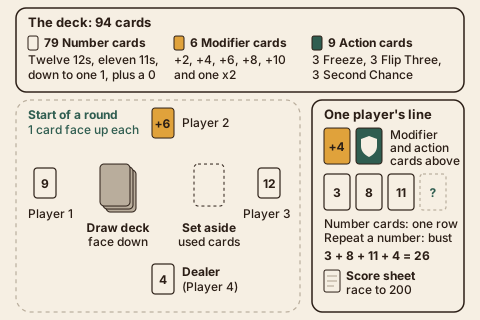
- Shuffle the whole deck thoroughly.
- Grab a pen and paper for scores. The publisher’s Flip 7 page has a printable scoresheet and a scoring web app.
- Choose a dealer for the first round.
- With more than 18 players, the rulebook recommends adding a second deck.
How does a round start?
The dealer deals one card face up to each player in turn order, themself included. If an action card comes up during the deal, the dealer pauses and it is resolved right away. Then the deal continues until everyone has been dealt a card.
So the table will not look even. Some players have a number card, some a modifier, some nothing, and a Flip Three can leave someone with three or four cards.
Hit or stay?
Now the dealer goes around the table, offering each player in turn a choice: hit or stay?
- Hit: the dealer deals you one more card, face up. Number cards go in a single row. Modifier and action cards go above the row.
- Stay: you leave the round and bank the points in front of you. You can stay only if you have at least one card.
If you are dealt a number that matches one already in your row, you bust. You are out of the round and score nothing for it. The rulebook suggests turning your cards face down when you are out, so everyone can see who is still playing.
An active player is anyone who has not busted or stayed. That word matters for every action card.
What do the action cards do?
When you are dealt an action card, you choose who gets it: any active player, yourself included. If you are the only active player left, it has to be you.
Freeze. The player who gets it banks the points they have and is out of the round.
Flip Three. The player who gets it must take the next three cards, flipping them one at a time. They stop early only if they bust or flip 7. Every card counts toward the three, modifiers and actions included. A Second Chance that turns up can be kept and used during the same Flip Three. A Freeze or another Flip Three waits until all three cards are flipped, and is used only if the player has not busted.
Second Chance. Keep this one. If you are later dealt a number you already have, discard both the duplicate and the Second Chance, and you stay in the round. Your turn ends there; your next card comes on your next turn. You can hold only one Second Chance at a time. If you are dealt another, give it to a different active player, or discard it if no one else can take one. Any unused Second Chance is discarded at the end of the round.
What do the modifier cards do?
Modifiers add points, but they are not number cards. You cannot bust on them, and they never count toward Flip 7.
- +2 to +10: add that amount to your number total.
- x2: double the total of your number cards, and only that.
You can stay with just a modifier in front of you and still score it, unless that modifier is the x2. Doubling nothing is still nothing.
How does a round end?
A round ends in one of two ways:
- Every player has busted or stayed.
- Someone gets seven different number cards in their row. The round ends at once, for everyone.
Then everyone scores, in this order:
- Add up your number cards.
- If you have the x2, double that total.
- Add any +2 to +10 modifiers.
- If you flipped 7, add 15 bonus points.
Busted players score nothing. A row of 3, 8, and 11 with a +4 above it scores 26. Swap the +4 for the x2 and it scores 44.
What happens between rounds?
Set every card from the round aside. Do not shuffle them back in. Pass the rest of the deck to the left; that player is the new dealer. When the deck runs out, shuffle the set-aside cards into a new deck. If that happens mid-round, leave the cards in front of players where they are, busted players included.
So the deck changes from round to round: a round full of 12s leaves fewer for the next. Lesson 7 shows how to use that.
How does the game end?
Keep playing rounds. At the end of any round where at least one player has 200 points or more, the player with the most points wins. If the top score is tied, the publisher’s official FAQ says everyone, not only the tied players, keeps playing more rounds until there is one winner.
Two players or fewer? The rulebook offers a challenge instead: how many rounds does it take you to reach 200?
That is the whole game. Keep the teach sheet on the table until nobody reaches for it.
Next lesson
How to Teach Flip 7 and Run a Great First Game
Next, the five-minute teach and how to run a first game: a host script, the action card questions to settle live, and the one bit of math worth sharing.
Get every lesson by email.
Learn Flip 7, teach it in five minutes, then count your odds, aim every action card, and win the race to 200 with a plan instead of a hunch. Free, one short lesson at a time.
Unofficial. Not affiliated with The Op or USAopoly, Inc. Flip 7 is a trademark of USAopoly, Inc.