Magic: The Gathering looks complicated from the outside because there are tens of thousands of different cards. The structure underneath them is small. Two players, 20 life each, and a turn that runs the same way every time. Cards bend those rules in specific ways, and each card tells you how.
This lesson shows how to play MTG in a two-player game, checked against the Comprehensive Rules effective September 25, 2026. Commander changes a few numbers, and the store night lesson covers those.
The play area
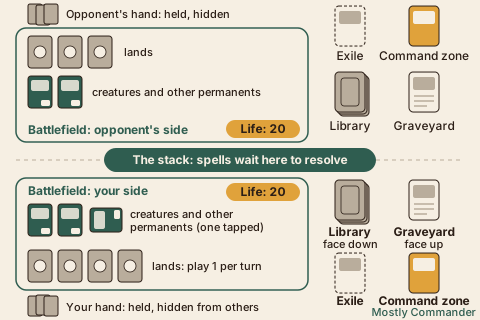
Magic has seven zones. Each player has their own library, hand, and graveyard. The other zones are shared, though each player keeps their own cards on their side of the table:
- Library: your deck, face down. You draw from the top.
- Hand: the cards you hold. Keep them hidden.
- Battlefield: the shared table space. Your lands, creatures, and other permanents sit on your side of it.
- Graveyard: your discard pile, face up. Destroyed creatures, finished instants and sorceries, and discarded cards go here.
- Exile: cards removed from the game, set apart and usually face up.
- The stack: where spells and abilities wait to resolve. It is a zone in the rules, not a pile you need space for.
- Command zone: used mostly in Commander, where your commander waits until you cast it.
Starting the game
- Decide who goes first. In the first game, any fair method works, like a coin flip. In a match of several games, the loser of the last game chooses.
- Shuffle. Your deck becomes your library.
- Each player starts at 20 life and draws 7 cards.
- Mulligan if you do not like your hand: shuffle it back, draw 7 new cards, then put 1 card on the bottom of your library for each mulligan you have taken. Repeat until you keep.
- The player who goes first skips the draw on their first turn.
The usual reason to mulligan is lands. A hand with zero or one land, or with six or seven, often cannot do much.
Lands and mana
Lands make mana, and mana pays for almost everything else.
- You may play one land per turn, during a main phase of your own turn. Playing a land is not casting a spell, so nobody can respond to it.
- Tap a land, turning it sideways, to add mana. Each of the five basic land types makes one color: Plains white, Island blue, Swamp black, Mountain red, Forest green.
- A card’s mana cost sits in its top right corner. Colored symbols need mana of that color. Number symbols are generic, and any mana pays them.
- Unused mana empties at the end of each step and phase. You cannot save it for later.
How to play an MTG turn: the five phases
Every turn has five phases, always in this order.
1. Beginning phase. Untap all your tapped permanents. Then the upkeep, when some cards trigger. Then draw a card.
2. First main phase. Play your land for the turn. Cast creatures, sorceries, artifacts, enchantments, planeswalkers, and battles. These can be cast only in your own main phase, when nothing is waiting on the stack.
3. Combat phase. Attack, if you want to. More on that below.
4. Second main phase. The same options as the first. If you held your land until after combat, play it now.
5. Ending phase. The end step, when cards that say “at the beginning of the end step” trigger. Then cleanup: if you have more than 7 cards in hand, discard down to 7, and damage on creatures wears off.
Instants break the timing rules on purpose. You can cast an instant, or activate an ability, any time you have priority, including during your opponent’s turn. That is where surprise blockers and last-second tricks come from.
Casting spells and the stack
When you cast a spell, it goes on the stack and waits. Each player then gets a chance to respond, usually with an instant. A response goes on top of the stack. When every player passes in a row, the top item resolves first. Then everyone gets another chance to respond. Last in, first out.
In your first games, the stack mostly means one habit: when someone casts a spell, pause a moment before it resolves, in case the other player wants to respond.
Combat
- Declare attackers. Choose which of your untapped creatures attack. Attacking taps them. A creature can attack only if you have controlled it continuously since your turn began. Players call this summoning sickness. A creature with haste ignores it.
- Declare blockers. The defending player chooses which of their untapped creatures block. Normally each blocker blocks one attacker, but several blockers can team up on the same attacker.
- Combat damage. Every creature deals damage equal to its power, all at the same time. An unblocked attacker hits the defending player, who loses that much life. A blocked attacker hits its blockers instead. If several creatures block it, its controller divides the damage among them.
A creature with damage marked on it equal to or greater than its toughness is destroyed and goes to the graveyard. Damage that does not destroy a creature wears off in the cleanup step.
How the game ends
You lose if:
- your life total is 0 or less,
- you have to draw a card from an empty library, or
- you have 10 or more poison counters.
You can also concede at any time. The last player standing wins.
That is the whole shape of a turn. The cards bring the variety, and the next lesson shows you how to read them. If you would rather learn by drafting your first deck instead of borrowing one, our piece on what a Magic cube is shows another way in.
Next lesson
How to Read a Magic Card, Part by Part
Next, reading a card: every part of a Magic card, labeled on a card we made up for this course.
Want the course by email?
Pick the right first box, learn how a turn works, read any card, and walk into your first Magic Academy, Commander night, prerelease, and draft ready to play, then climb as far toward the Pro Tour as you like. Free, one short lesson at a time.
First Land to First Draft is unofficial Fan Content permitted under the Fan Content Policy. Not approved/endorsed by Wizards. Portions of the materials used are property of Wizards of the Coast. ©Wizards of the Coast LLC.