New players tend to read a Magic card the way they read a menu: the name, the big number, done. The rest of the card is where games are decided. The word “Legendary” that limits how many you can control. The keyword that lets a creature attack without tapping. The tiny symbol that tells you how rare the card is and nothing about how it plays.
Here is an invented card, drawn for this course, with every part labeled. It follows the layout of a current Magic card, but the name, the text, and the art are all ours.
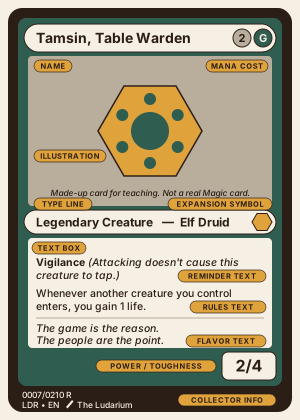
The name and the mana cost
The name sits at the top left. It matters more than it looks. A constructed deck may hold no more than four cards with the same English name, basic lands aside, and a Commander deck only one.
The mana cost sits at the top right. Tamsin costs two generic mana plus one green.
- The colored symbols are white, blue, black, red, and green. The rules write them as W, U, B, R, and G. Blue is U because B was already taken by black.
- A number is generic mana. Any type of mana can pay it.
- Add up every symbol and you get the card’s mana value. Tamsin’s is 3.
- A card’s color comes from the symbols in its mana cost, not from the color of its frame. Tamsin is green.
The illustration
The art sets the mood and has no effect on the game. Ours shows a round table with six chairs, because that is our kind of magic.
The type line
The bar under the art reads left to right.
- Supertype, if the card has one, such as Legendary or Basic. Legendary matters: if you control two legendary permanents with the same name, you keep one and the rest go to the graveyard. Players call this the legend rule. Legendary creatures can also lead a Commander deck.
- Card type, such as Creature. It tells you when you can cast the card and what it does once it resolves.
- After a dash, subtypes, such as Elf and Druid. They matter when other cards mention them, like a card that boosts every Elf you control.
Here are the card types you will meet first:
| Card type | What it does |
|---|---|
| Land | Played, not cast. One per turn. Makes mana. |
| Creature | A permanent that attacks and blocks. |
| Artifact | A permanent, often colorless, often a tool or a machine. |
| Enchantment | A permanent with an ongoing effect. |
| Instant | A one-time effect you can cast any time you have priority. |
| Sorcery | A one-time effect cast only in your own main phase. |
| Planeswalker | A permanent ally whose loyalty rises and falls as you use its abilities. |
| Battle | A permanent with defense that players attack to defeat. |
The expansion symbol
At the right end of the type line, a small icon shows which set the card comes from. Its color shows rarity: black or white for common, silver for uncommon, gold for rare, and red-orange for mythic rare. Our hexagon is gold, so Tamsin is a rare. Rarity has no effect on play. A common can win the game.
The text box
The lower half of the card holds what it does.
- Rules text is the card’s abilities. Vigilance is a keyword: a single word that stands for a longer rule.
- Reminder text is italic and in parentheses. It explains a keyword in plain words, and it is not a separate rule.
- Flavor text is italic and sits below the rules. It is story, with no game effect. Ours borrows our motto.
Three patterns cover most of what you will read. A line starting with “When,” “Whenever,” or “At” is a triggered ability: it happens on its own when the condition is met. A cost followed by a colon, like “Tap: draw a card,” is an activated ability: you pay the cost to use it. On a permanent, most other text simply works all the time. And “enters” means enters the battlefield.
Power and toughness
The box at the bottom right, on creatures only. Tamsin is 2/4: she deals 2 damage in combat, and she is destroyed once she has 4 or more damage marked on her in a turn. Planeswalkers show loyalty in that corner, and battles show defense.
The small print
Below the text box, in the border, sits information with no effect on play:
- the collector number, sometimes written as number over set total, followed by a rarity letter,
- the three-character set code and two-character language code, separated by a dot, or by a star on premium cards,
- the artist credit, after a small paintbrush icon,
- and the legal text.
The set code and collector number together name the exact printing. That helps when you buy single cards, which the budget upgrades lesson covers at Level 1.
When a card and the rules disagree
The card wins. The Comprehensive Rules start from that idea: when a card’s text directly contradicts a rule, the card takes precedence for that situation. If an older card’s wording looks odd, look up its current official text in Wizards’ Gatherer card database.
Our card drafting explainer is a good next read once card reading feels easy, because drafting is mostly reading cards quickly and well.
Next lesson
How to Teach Magic in Ten Minutes
Next, the ten-minute teach: a host script for teaching Magic to a friend with the Beginner Box, plus a printable teach sheet.
Want the course by email?
Pick the right first box, learn how a turn works, read any card, and walk into your first Magic Academy, Commander night, prerelease, and draft ready to play, then climb as far toward the Pro Tour as you like. Free, one short lesson at a time.
First Land to First Draft is unofficial Fan Content permitted under the Fan Content Policy. Not approved/endorsed by Wizards. Portions of the materials used are property of Wizards of the Coast. ©Wizards of the Coast LLC.