A One Piece card packs a lot into a small space. The good news is that the layout is the same on every card of a category, so once you can read one Character, you can read them all.
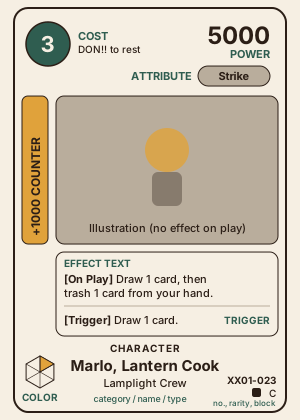
The card below is invented for this lesson. The name, art box, and text are our own, not a real card. It shows where each part sits on a Character card.
Cost, power, and Counter: the three numbers
Cost, in the upper left corner, is how many active DON!! you rest to play the card. Characters, Events, and Stages have a cost. Leaders do not.
Power, at the top right, is the card’s strength in battle. Only Leaders and Characters have power. An attacker wins if its power is equal to or higher than the target’s.
Counter, along the left edge, is the power this card adds when you trash it from your hand during the Counter Step of your opponent’s attack. Only Characters have it, and not every Character does. A Character without a Counter value cannot be used that way.
That last number is easy to overlook, and it is half of the card’s value. Every Character in your hand is both a crew member you might play and a shield you might throw.
Color, type, and attribute
Color shows in a small hexagon in the lower left, split into six sections. A card can have one color or two. A two-color card counts as both colors, so it fits a deck whose Leader has either one.
Type sits under the name, such as a crew or organization. Some cards have more than one, split by a slash. Card text often refers to a type in curly brackets, like “your {Lamplight Crew} Characters.”
Attribute is shown near the power: Slash, Strike, Ranged, Special, Wisdom, or a question mark. Only Leaders and Characters have one. It does nothing on its own, but some effects check it.
The text box: read the brackets first
Card text starts with a timing word in square brackets. It tells you when the effect happens, which matters more than what it does. The common ones:
- [On Play] happens when you play the card.
- [When Attacking] happens when this card declares an attack.
- [Activate: Main] you may use during your Main Phase, outside battle.
- [DON!! x1] works only while this card has at least 1 DON!! given to it. The number can be higher.
- [Once Per Turn] limits an effect to one use each turn.
- [Your Turn] and [Opponent’s Turn] limit when an effect is on.
You will also see DON!! −1 or a higher number as a cost. It means return that many DON!! from your field to your DON!! deck. It is a real price, because those DON!! will not help you again until they are added back.
When card text and the rules disagree, the card text wins.
Triggers
Some cards have a [Trigger] line at the bottom of the text box. When your Leader takes damage and the Life card you would add to your hand has a Trigger, you may reveal it and use the Trigger instead. After the Trigger resolves, the card goes to the trash unless it says otherwise. Triggers are the surprise in every game: a hit on your Leader might draw a card, stop an attacker, or bring a Character into play.
Keywords worth knowing first
- Rush: this Character can attack on the turn it is played.
- Blocker: during your opponent’s attack, rest this card to make it the new target.
- Double Attack: a Leader hit by this card takes 2 damage, not 1.
- Banish: a Leader hit by this card trashes the Life card instead of adding it to hand. The Trigger is lost too.
- Unblockable: your opponent cannot use Blocker against this card.
Leaders, Events, and Stages
Leader cards have power, Life, color, type, and attribute, but no cost and no Counter. The Life number sits in the lower right.
Event cards have a cost and an effect. You trash the card as you use it. [Main] Events are played in your Main Phase. [Counter] Events are played during your opponent’s attack, after you pay their cost.
Stage cards have a cost and an effect that stays on the table. You can have one Stage at a time.
DON!! cards have no text you need to read in a first game. They pay costs and add power.
The small print at the bottom
The card number, such as a set code and a number, sits in the lower right corner with the rarity and the block symbol. The card number is what the 4-copy limit counts. Rarity does not change how a card plays. The block symbol does not affect play either, but it tells you which group of sets a card belongs to, which matters for which cards are legal in the main tournament format.
Pick up your starter deck and read three Characters out loud: cost, power, Counter, and the bracket in their text. Once you can do that without looking at this page, you are ready to teach.
Next lesson
How to Teach the One Piece Card Game
Next, the ten-minute teach. A host script in the order you would say it, so a new friend can play a real game tonight.
Want the course by email?
Pick the right starter, learn the Leader and DON!! rhythm, teach a friend, and walk into your first store tournament ready to play. Free, one short lesson at a time.
Unofficial. Not affiliated with or endorsed by Bandai, Shueisha, or Toei Animation. The ONE PIECE CARD GAME is published by Bandai. ONE PIECE © Eiichiro Oda/Shueisha, Toei Animation.