Most trading card games teach you the cards first. The One Piece Card Game is easier to learn the other way around. Start with the two pieces that are always on the table, your Leader and your DON!! deck, and the turn makes sense before you have read a single Character.
Everything here follows the official Comprehensive Rules, version 1.2.1.
The Leader card
Your Leader starts face up in the Leader area and never leaves it. It does three jobs:
- It sets your colors. Every card in your deck must share a color with it.
- It sets your Life. The Life number on the Leader is how many face-down Life cards you start with.
- It attacks. Your Leader has power like a Character, and it can attack on each of your turns after your first.
Many Leaders also have an effect that shapes how the deck plays. Read yours before your first game.
The DON!! deck
DON!! cards are your resource, and they come from their own 10-card stack. Each turn you move 2 of them into your cost area. You use them in two ways:
- Pay costs. To play a card, rest (turn sideways) active DON!! cards equal to its cost.
- Give them. Tuck an active DON!! under your Leader or a Character. That card gets 1000 more power for each DON!! given to it, during your turn.
Every DON!! you give is one you cannot spend, so each turn is a small choice between building your crew and hitting harder.
Setting up
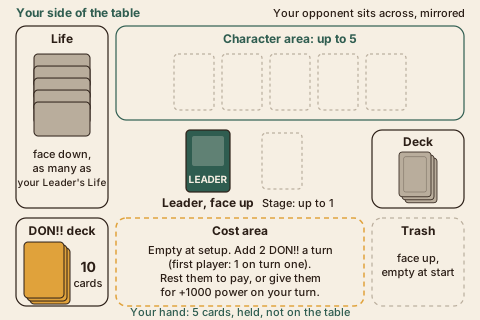
- Shuffle your 50-card deck and put it face down in the deck area.
- Put your Leader face up in the Leader area, and your 10 DON!! cards in the DON!! deck area.
- Play rock-paper-scissors. The winner chooses whether to go first or second.
- Draw 5 cards. Each player may redraw once: shuffle the 5 back in and draw 5 new ones. The first player decides first.
- Take cards from the top of your deck equal to your Leader’s Life and put them face down in your Life area without looking.
The five phases
1. Refresh. Any DON!! you gave to cards last turn come back to your cost area. Then every rested card you have stands back up.
2. Draw. Draw 1 card. The player going first skips this on their very first turn.
3. DON!!. Move 2 DON!! cards from your DON!! deck to your cost area. The player going first moves only 1 on their first turn. If your DON!! deck is empty, you add none.
4. Main. This is the turn itself. You can do any of these, in any order, as often as you can:
- Play a Character or Stage card, or use a [Main] Event card, by paying its cost.
- Use effects on your cards that say you can activate them in the Main Phase.
- Give DON!! to your Leader or Characters.
- Battle.
5. End. Resolve any end of turn effects, and the turn passes.
Two limits matter early. Neither player can battle on their own first turn. And a Character cannot attack on the turn it is played unless its text says so. You can have up to 5 Characters and 1 Stage at a time. Play a sixth Character and you trash one of your five to make room.
How a battle works
To attack, rest your Leader or an active Character. Choose a target: the other player’s Leader, or one of their Characters that is rested. Active Characters cannot be attacked, which is why attacking with a Character leaves it exposed.
Then the defender gets two chances to respond:
- Block. They may rest one Character with Blocker to make it the new target.
- Counter. They may trash Character cards with a Counter value from their hand to add that power to their Leader or one of their Characters for this battle, usually the card being attacked. They may also pay for Event cards that say Counter.
Finally, compare power. If the attacker’s power is equal to or higher than the target’s, the attacker wins. Ties go to the attacker.
- A Character that loses is K.O.‘d and goes to the trash.
- A Leader that loses takes 1 damage. Its player moves the top Life card into their hand. If that card has a Trigger, they may reveal it and use the Trigger instead.
That second rule is the heart of the game. Damage hurts, but it also hands the defender a card. The player who is behind on Life often has more cards to fight back with.
How do you win?
Your opponent loses when their Leader takes damage while they have 0 Life cards. They also lose if their deck reaches 0 cards, which is rare but real in long games.
Now you know the shape of every turn. The next lesson makes the cards themselves readable.
Next lesson
How to Read a One Piece Card
Next, reading a card. We take apart an invented card, piece by piece, so every number and bracket makes sense.
Want the course by email?
Pick the right starter, learn the Leader and DON!! rhythm, teach a friend, and walk into your first store tournament ready to play. Free, one short lesson at a time.
Unofficial. Not affiliated with or endorsed by Bandai, Shueisha, or Toei Animation. The ONE PIECE CARD GAME is published by Bandai. ONE PIECE © Eiichiro Oda/Shueisha, Toei Animation.