Sushi Go! is a card game about a sushi conveyor belt. Hands of cards travel around the table like plates on a belt, and each turn you grab one dish before the rest roll on to the next player. It plays in about 15 minutes with 2 to 5 players, and it is one of the cleanest introductions to card drafting there is. Everything below comes from the official Gamewright rules.
What is in the box
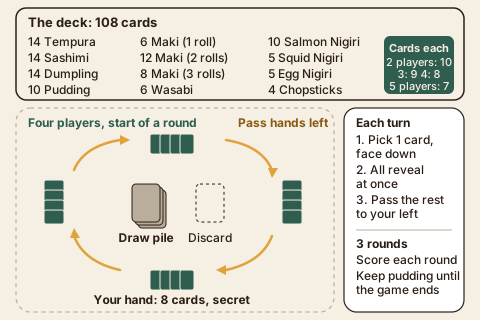
One deck of 108 cards:
- 14 tempura, 14 sashimi, 14 dumplings
- 26 maki rolls: 6 cards with 1 roll, 12 with 2 rolls, 8 with 3 rolls
- 20 nigiri: 10 salmon, 5 squid, 5 egg
- 10 pudding, 6 wasabi, 4 chopsticks
You also need a piece of paper and a pencil. There is no scorepad in the box.
Setup
Shuffle the whole deck well. Deal each player a hand based on the number of players:
- 2 players: 10 cards each
- 3 players: 9 cards each
- 4 players: 8 cards each
- 5 players: 7 cards each
Hold your hand secret. Put the rest of the deck face down in the middle as the draw pile. Pick one player to keep score.
A turn
Every turn, everyone plays at once.
- Pick. Choose any one card from your hand that you want to keep, and put it face down in front of you.
- Reveal. When everyone has picked, flip your chosen cards face up together.
- Pass. Pass the rest of your hand face down to the player on your left. Pick up the hand you were passed.
Your new hand has one fewer card, and it is a hand you have never seen before. Face-up cards stay in front of you until the round is scored, so group matching cards together to make scoring easy.
When the last card of each hand is passed on, just put it face up with your other cards. Then the round is over.
Wasabi
If you take a squid, salmon, or egg nigiri and already have a wasabi in front of you, the nigiri goes on top of the wasabi. That nigiri now scores triple. You can have more than one wasabi, but each wasabi holds only one nigiri.
Chopsticks
Chopsticks let you take two cards on a later turn. Once you have chopsticks face up in front of you, pick your first card as usual. Then, before everyone reveals, call out “Sushi Go!” and take a second card from your hand, also face down. Everyone reveals.
Before you pass your hand, put the chopsticks card back into it. The chopsticks travel on, and another player can take them and use them later. You can hold more than one chopsticks card, but you can use only one per turn.
Scoring a round
When the round ends, score each type of card:
- Maki rolls. Count the roll icons at the top of your maki cards. Most icons scores 6. Second most scores 3. If players tie for most, they split the 6, rounding down, and no one scores second place. If players tie for second, they split the 3.
- Tempura. Each pair scores 5. A single tempura scores nothing.
- Sashimi. Each set of three scores 10. One or two sashimi score nothing.
- Dumplings. 1 dumpling scores 1, 2 score 3, 3 score 6, 4 score 10, and 5 or more score 15.
- Nigiri. Squid scores 3, salmon 2, egg 1. On a wasabi: squid 9, salmon 6, egg 3.
- Wasabi with no nigiri on it, and chopsticks, score nothing.
Pudding is not scored yet.
The next round
Announce your round scores to the scorekeeper. Discard your face-up cards beside the draw pile, except pudding: keep your pudding cards in front of you. Deal a new hand of the same size from the draw pile and play again. The game lasts three rounds. Any cards left in the draw pile at the end are not used.
Dessert: scoring pudding
After the third round is scored, score pudding:
- Most pudding scores 6. Ties split the points, rounding down.
- Fewest pudding, counting players with none, loses 6. Ties split the loss, rounding down.
- Everyone tied: no one scores anything for pudding.
- With 2 players, no one loses points for pudding. Only most pudding scores.
Winning
The player with the most points after three rounds wins. If players are tied, the one with the most pudding cards wins.
That is the whole game. The rest of this course is about choosing well: what each card is really worth, how to read the hands coming your way, and how to win the maki and pudding races. If drafting is new to you, our piece on card drafting explains why pick and pass games work so well.
Next lesson
How to Teach Sushi Go! in Five Minutes
Next, how to teach it: a five-minute host script that gets cards moving before anyone's attention drifts, with each special card explained the moment it shows up.
Get every lesson by email.
Learn Sushi Go!, teach it in five minutes, then read every hand that comes your way, win the maki and pudding races, and pick like a chef. Free, one short lesson at a time.
Unofficial. Not affiliated with Gamewright, Ceaco, or Phil Walker-Harding. Sushi Go! is a trademark of Gamewright, a division of Ceaco, Inc.