Drafting is the heart of a Cube night. It is also the part that looks most confusing from the outside: eight people passing small stacks of cards in silence, one card at a time, with the direction changing every so often. Once you have done it, it feels as natural as dealing a hand of cards.
The draft procedure in this lesson follows the Magic: The Gathering Tournament Rules from Wizards of the Coast, which set the official procedure for store and tournament drafts. Casual Cube nights borrow the same structure and relax the parts a kitchen table does not need.
The table at a glance
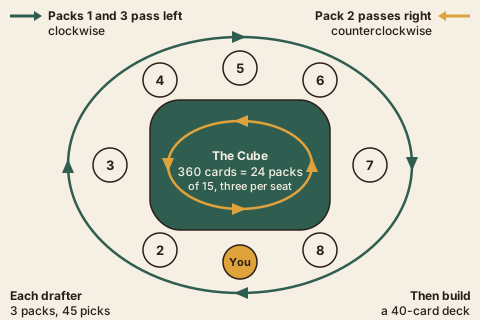
Eight drafters sit around one table. A 360-card Cube makes exactly 24 packs of 15, three for each seat. That is why 360 is the classic Cube size.
Before the first pick
The host shuffles the Cube and deals the packs face down, usually before anyone arrives. Each seat gets three. Nobody looks at a pack until the host calls the start.
If your Cube is bigger than 360 cards, the extra cards simply stay in the box that night. That is part of what keeps a big Cube fresh. Our piece on Cube pack size has the arithmetic for other sizes.
The pick
When the host says go, everyone opens their first pack and does three things:
- Look at the 15 cards.
- Take one and put it face down on a single pile in front of you.
- Pass the rest face down to the next player.
Then you pick up the pack that was passed to you, which now has 14 cards, and do it again. The packs shrink by one card each pick until the last card is taken.
The Tournament Rules treat a card as picked once it goes on your pile. Casual tables usually follow the same habit: once it is on the pile, it stays there.
Left, right, left
The direction is the rule people forget most:
- Pack 1 passes to your left.
- Pack 2 passes to your right.
- Pack 3 passes to your left again.
Seen from above, left is clockwise around the table and right is counterclockwise, as the diagram shows. Flipping the direction means the neighbors who fed you in pack 1 are the ones you feed in pack 2. It keeps the draft fair.
What you can see, and what you can say
During the draft, you look at the pack in your hands. You do not show your picks to anyone, and you do not show anyone the pack you are holding.
The Tournament Rules also ban sharing hidden information about your picks, or telling others what you want them to take. Most Cube groups keep that rule even in the living room, because it is what makes the draft a puzzle. Talking about anything else is fine. Talking about the cards in the packs is not.
At Regular Rules Enforcement Level, the relaxed level most store tournaments use, the rules let you look back through your picks as long as you are not holding any other cards at the same time. Stricter events do not allow it. There is also a short review period between packs. Use it to count your colors.
How long does a pick take?
In official booster drafts, the first pick of a pack gets 40 seconds, and the time drops as the pack gets smaller, down to 5 seconds near the end. The review between packs is 60 seconds after pack 1, then 30 seconds longer after each pack after that.
Casual Cube nights rarely run a strict clock, but slow picks add up fast with eight people waiting. A whole draft of 45 picks usually takes 40 to 45 minutes. Our guide to draft timers has a relaxed schedule that keeps a table moving without a judge.
Why your first pack comes back
With eight drafters and 15-card packs, the pack you opened goes all the way around the table and returns to you at pick 9, with 7 cards left. Drafters call this a pack “wheeling.”
It matters because it tells you something. If a strong red card is still in your first pack when it wheels, seven other people passed it. Red might be open. Reading those hints is called reading signals, and our card drafting explainer covers how it works.
After the last pick
After pack 3, you have 45 cards. You build a deck of at least 40 cards from them, adding as many basic lands as you like. Every card you do not play is your sideboard for the night. The deckbuilding lesson that opens Level 1 covers building in detail.
What if you do not have eight?
Eight is the classic count, not the only one.
- Four to seven players: deal three packs of 15 per player as usual. Everyone still gets 45 picks, because each pack comes around more often. Our piece on Cube pack size works through each count.
- Three or four players: Grid draft gives every pick a real choice.
- Two players: Winston and Grid draft were made for this. See our guide to two-player Cube formats.
A short draft with three friends is still a Cube night. The box does not mind.
Next lesson
How to Read a Magic Card and Make Good Cube Picks
Next, reading a card: every part of a Magic card on one invented example, and how to judge which card to take.
Want the course by email?
Learn what a Cube is, draft and build a deck with confidence, host a night your friends ask to repeat, and start a Cube of your own. Free, one short lesson at a time.
One Box, Eight Friends is unofficial Fan Content permitted under the Fan Content Policy. Not approved/endorsed by Wizards. Portions of the materials used are property of Wizards of the Coast. ©Wizards of the Coast LLC.