A Cube pack hands you 15 cards and a few seconds. New drafters read the name and the art and miss the rest. The rest is where the decisions live: the colored symbol that ties a card to one color, the toughness that decides whether it survives, the one line of text that makes it a bomb.
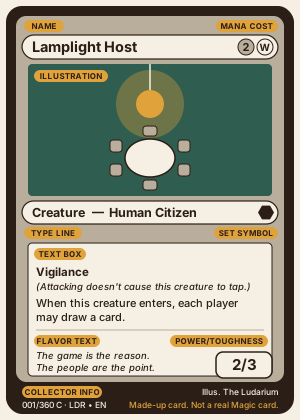
Here is an invented card, drawn for this course, with every part labeled. It follows the layout of a modern Magic card, but the name, the text, and the art are made up.
The top line: name and cost
Name, top left. Names matter for rules that check them, and for talking about the card across the table.
Mana cost, top right. This is what you pay to cast the card. A number is generic mana, which any kind of mana can pay. A colored symbol needs mana of that color. Lamplight Host costs two generic mana and one white mana.
Two numbers come out of the cost:
- Mana value. The total amount of mana in the cost, regardless of color. Lamplight Host has a mana value of 3.
- Color. A card is the color of the mana symbols in its cost. One white symbol makes this a white card. A card with two colors of symbols is multicolored, often called gold.
The middle: what it is
Illustration. Art and nothing more. It has no effect on the game.
Type line, below the art. It shows the card type, with any supertype such as legendary in front, then a dash and any subtypes. Lamplight Host is a creature, with the subtypes Human and Citizen. The card types you will meet most in a Cube are creature, instant, sorcery, artifact, enchantment, planeswalker, and land. The type tells you when you can play it: a creature or sorcery only in your own main phase, an instant almost any time.
Set symbol, at the right end of the type line. It shows which set the card came from, and its color shows rarity. In a Cube, rarity barely matters. The owner chose every card, so a common can be the best card in the pack.
The text box: what it does
Rules text is what the card does in the game. Read every word. Vigilance is a keyword ability, a short name for a longer rule.
Reminder text is in italics and parentheses, and it explains a keyword. It has no game function of its own, so you can skip it once you know the keyword.
Flavor text is the italic line at the bottom. Like the art, it is there for the story and does nothing in the game.
The bottom: how it fights
Power and toughness, bottom right, appear on creatures. The first number is power, the damage it deals in combat. The second is toughness, the damage it takes to destroy it. A 2/3 deals 2 and survives 2 damage.
Collector information, at the very bottom: card number, rarity letter, set code, language, and the artist credit. None of it affects play.
From reading to picking
Reading a card tells you what it does. Picking asks a harder question: will it make your deck better than the other 14? A few rules of thumb carry most new drafters a long way.
Early, take power. For your first few picks, take the card most likely to win a game on its own. You have no colors yet, so you lose nothing by taking the strongest card.
Removal comes early. A cheap spell that destroys or damages a creature is almost always a better pick than a creature of the same cost. Every deck needs answers. Our piece on interaction in Cube explains why Cube games reward it.
Cheap beats big. A two-mana creature you cast every game is worth more than a seven-mana creature you cast once a night. Look at the mana value first.
Count colored symbols. One colored symbol is easy to cast in a two-color deck. Two or three of the same symbol ask you to be deep in that color. A gold card asks for both of its colors, so it is a commitment. Take gold cards late, or take one early and treat it as a decision.
After a few picks, lean in. Once you have a few good cards in two colors, favor the best card in those colors over a slightly better card outside them.
Our one-page Cube draft guide turns these into a sheet you can read in the car. When you want more, Cube draft strategy covers signals and when to commit, and Cube archetypes explained shows the two-color decks most Cubes support.
Practice without a draft
You can practice reading before a draft night. Pull up any Cube list, pick ten cards at random, and for each one say its mana value, its colors, its type, and one sentence about what it does. Our guide to reading a Cube list shows how to skim a whole list in ten minutes.
Next lesson
How to Teach a Cube Draft in Ten Minutes
Next, the ten-minute teach: a host script for running a Cube draft night, plus a printable teach sheet for the table.
Want the course by email?
Learn what a Cube is, draft and build a deck with confidence, host a night your friends ask to repeat, and start a Cube of your own. Free, one short lesson at a time.
One Box, Eight Friends is unofficial Fan Content permitted under the Fan Content Policy. Not approved/endorsed by Wizards. Portions of the materials used are property of Wizards of the Coast. ©Wizards of the Coast LLC.