The Ludarium Academy · Trading card game course · Free
One Box, Eight Friends
An unofficial Magic Cube draft course for beginners
Learn what a Cube is, draft and build a deck with confidence, host a night your friends ask to repeat, and start a Cube of your own.
 Free printable teach sheetSetup, a turn, scoring, and three tips on one page.
Six levels, 23 lessons
Start with lesson oneLevel 0 · Learn to play
Guest
After this level: Explain what a Cube is, follow a draft from the first pick to the last, read any card, and teach the draft to a friend in ten minutes.
Level 1 · Beginner
Drafter
After this level: Build a two-color, 40-card deck that casts its spells on time, dodge the classic first-draft mistakes, and choose your deck's speed on purpose.
Level 2 · Intermediate
Reader
After this level: Read signals from what passes and what wheels, rank picks by the job they do, build a mana base by the numbers, and win the long games.
Level 3 · Advanced
Strategist
After this level: Draft aggro and control on purpose, adjust your picks for two to seven drafters, and keep your discipline in a high-power Cube.
Level 4 · Expert
Curator
After this level: Build and balance a Cube of your own, improve it with real draft data, and host a regular night people come back to.
Level 5 · Mastery
Keeper
After this level: Give your Cube an identity of its own, sharpen your drafting with a practice plan, and grow the community around the box.
- 1What Is a Cube Draft? The Best Way to Play Magic With Friends
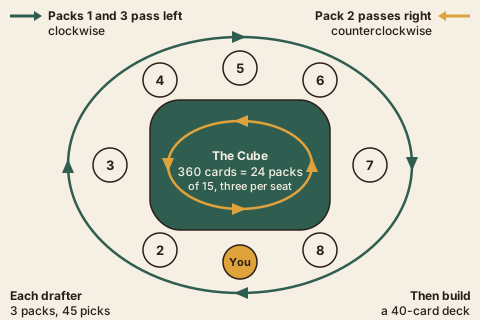
- 2How a Cube Draft Works: Eight Seats, Three Packs, 45 Picks
- 3How to Read a Magic Card and Make Good Cube Picks
- 4How to Teach a Cube Draft in Ten Minutes
- 5Cube Deck Building: From 45 Picks to a 40-Card Deck
- 6Your First Cube Draft Night: Etiquette, Timing, and Giving the Cards Back
- 7Your First Three Cube Drafts: The Mistakes Everyone Makes
- 8Aggro, Midrange, Control: The Three Speeds of a Cube Deck
- 9Reading Signals in a Cube Draft: What the Packs Tell You
- 10Cube Pick Orders: Power, Removal, Fixing, and Flexibility
- 11Cube Mana by the Numbers: Colored Sources, Splashes, and Fixing
- 12Playing Cube Games Well: Card Advantage, Tempo, and Patience
- 13Drafting Aggro in Cube: Cheap Threats, Reach, and Discipline
- 14Drafting Control and Ramp in Cube: Winning the Long Game
- 15Drafting a Cube With Two to Seven Players: What Changes
- 16Drafting a High-Power Cube: Fast Mana, Power, and Discipline
- 17How to Build a Cube: Size, CubeCobra, Budget, and Proxies
- 18Designing Your Cube: Archetypes, Color Balance, and Signposts
- 19Curating a Cube: Draft Data, What to Cut, and a Changelog
- 20Running a Regular Cube Night: Pairings, Records, and Regulars
- 21Building a Signature Cube: Themes, Restrictions, and Identity
- 22A Practice Plan for Cube Drafting: Six Weeks to Sharper Picks
- 23What Comes Next: Cube Formats, Local Drafts, and Online Play
Every lesson is free to read here, any time. Sign up and they also arrive by email, one at a time, so the course keeps you learning between game nights.
Who it is for
- Magic players who want a format where nobody buys packs and every pick matters.
- Friends who want a regular game night built around one shared box of cards.
- Newer players who know a little Magic and want a welcoming first draft.
- Collectors and tinkerers curious about building a Cube of their own.
- Players
- 2 to 8
- Play time
- About 3 hours for a draft and two rounds
- Rules as of
- Reality Fracture (released October 2, 2026; Comprehensive Rules effective September 25, 2026), ahead of Magic: The Gathering | Star Trek on November 13, 2026
- Start with
- No product needed to join a Cube; to learn Magic's basics first, a Magic: The Gathering Starter Kit
- First store event
- A Cube draft night hosted by a friend or a local store; for official store play, Magic Academy, then a Friday Night Magic Booster Draft
Set alerts
Release dates, a prerelease checklist, and beginner buying notes before every new Magic Cube draft set.
Play near me
Learning in Indianapolis? Join the Indianapolis list for first word on local learn-to-play nights as The Ludarium grows toward its first lounge.
Join the Indianapolis listQuestions
What is a Cube draft in Magic: The Gathering?
A Cube is a set of hand-picked Magic cards, usually 360 or more, that one owner keeps for drafting. Players deal it into packs of 15, draft them like booster packs, build 40-card decks, and play. At the end of the night, every card goes back in the box.
Do you keep the cards you draft in a Cube?
No. The Cube belongs to its owner, and every card goes back into it when the night ends. That is why a Cube draft usually costs the players nothing to join.
How many cards are in a Cube?
Eight drafters with three packs of 15 use 360 cards, so 360 is the classic size. Larger Cubes of 450 or 540 cards change what shows up each night. A 180-card Cube works well for four players.
How many lands should a Cube deck play?
The rules only require at least 40 cards, and basic lands are free to add. Most Cube drafters play 17 lands and 23 spells, and fewer lands only when the deck's spells are very cheap.
Can you Cube draft with fewer than eight players?
Yes. Four to seven players can draft three packs of 15 each as usual, since each pack simply comes around more often, and two players can use formats such as Winston draft or Grid draft. Eight is the classic count because 360 cards divide evenly.
Are proxies allowed in a Cube?
In a casual Cube, that is the owner's call, and it should be said out loud before anyone drafts. Player-made proxies are not legal in sanctioned tournaments, and a fake made to pass as a real card is a counterfeit. The lesson on building a Cube covers the details.
Teach sheet · PDF · Rules as described in the Magic: The Gathering Comprehensive Rules effective September 25, 2026, with the Magic: The Gathering Tournament Rules of February 27, 2026 for draft procedure; official rules.
One Box, Eight Friends is unofficial Fan Content permitted under the Fan Content Policy. Not approved/endorsed by Wizards. Portions of the materials used are property of Wizards of the Coast. ©Wizards of the Coast LLC.