The Pokémon TCG looks busy, with cards everywhere and counters piling up. Underneath, each turn follows the same simple rhythm. This lesson walks through the Pokémon card game rules in the order the current official rulebook does, from the handshake to the last Prize card.
How do you win?
There are three ways:
- Take all of your Prize cards. Each player starts with 6.
- Knock Out your opponent’s last Pokémon in play, so they have nothing to move into the Active Spot.
- Your opponent has no cards in their deck at the start of their turn.
Most games end the first way.
The play area
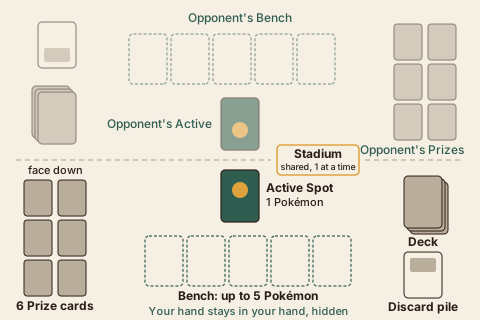
- Active Spot. Your one Pokémon in the fight. You must always have one here.
- Bench. Up to 5 more Pokémon waiting their turn.
- Prize cards. 6 cards set aside face down from your own deck.
- Deck and discard pile. Nobody looks at or changes the order of a deck unless a card says so. Used cards go to the discard pile.
- Hand. Your cards stay hidden from your opponent.
How do you set up?
- Shake hands with your opponent.
- Flip a coin. The winner decides who goes first.
- Shuffle your 60-card deck and draw 7 cards.
- Put one Basic Pokémon face down as your Active Pokémon.
- Put up to 5 more Basic Pokémon face down on your Bench.
- Set the top 6 cards of your deck aside, face down, as your Prize cards.
- Both players flip their Pokémon face up and the game begins.
No Basic Pokémon in your opening hand? That is a mulligan. Reveal your hand, shuffle it back, and draw 7 new cards. Repeat until you have one. Each time you do this, your opponent may draw one extra card.
What do the Pokémon TCG rules let you do on a turn?
1. Draw a card. If your deck is empty and you cannot draw, you lose.
2. Do any of these, in any order:
- Put Basic Pokémon onto your Bench, as many as you want, up to 5 there.
- Evolve your Pokémon, as many as you want. Play a Stage 1 card on the Basic Pokémon it evolves from, or a Stage 2 on its Stage 1. It keeps its damage and attached cards, and Special Conditions end.
- Attach one Energy card from your hand to one of your Pokémon, Active or Benched. Only once per turn.
- Play Trainer cards. Items and Pokémon Tools, as many as you like. Only one Supporter card and one Stadium card per turn.
- Retreat your Active Pokémon, once per turn. Discard Energy from it equal to its Retreat Cost, then swap it with a Benched Pokémon. You can still attack with the new one.
- Use Abilities, as many as the cards allow. Abilities are not attacks, so you can use them and still attack.
3. Attack. Your turn ends when you attack.
Rules for the first turns
- The player who goes first skips attacking on their first turn.
- The player who goes first cannot play a Supporter on their first turn.
- Neither player can evolve on their own first turn, and you cannot evolve a Pokémon the same turn it came into play.
So going first means you set up, and going second means you get the first hit. Think about which you want when you win the coin flip.
How does attacking work?
- Check the Energy. The attack’s cost must be covered by Energy attached to your Active Pokémon. A colorless star in the cost can be paid with any type.
- Check Weakness and Resistance on your opponent’s Active Pokémon. Weakness raises the damage, usually doubling it. Resistance lowers it. Benched Pokémon never apply either.
- Place damage counters. One counter for each 10 damage.
When a Pokémon has damage at least equal to its HP, it is Knocked Out. It goes to its owner’s discard pile with everything attached. The attacker takes 1 Prize card, or 2 for a Pokémon ex, or 3 for a Mega Evolution Pokémon ex. Then the other player picks a new Active Pokémon from their Bench. If they cannot, the attacker wins.
Pokémon Checkup and Special Conditions
Between turns comes Pokémon Checkup. Poisoned, Burned, Asleep, and Paralyzed resolve there, in that order. Confused is different: it only matters when the Pokémon attacks.
| Condition | What it does |
|---|---|
| Poisoned | 1 damage counter during each Checkup |
| Burned | 2 damage counters, then flip a coin; heads, it recovers |
| Asleep | Can’t attack or retreat; flip during Checkup, heads wakes it |
| Paralyzed | Can’t attack or retreat; recovers after its owner’s next turn |
| Confused | Flip before attacking; tails, the attack fails and it takes 3 damage counters |
Only an Active Pokémon can have a Special Condition. Moving to the Bench or evolving clears all of them.
Build your own deck later
When you build a deck of your own, it must be exactly 60 cards, with no more than 4 copies of any card with the same name except Basic Energy, and at least one Basic Pokémon. You can have only one ACE SPEC card in the whole deck. The deck building lesson at Level 2 has more.
Next lesson
How to Read a Pokémon Card, Part by Part
Next, reading a card. We label every part of a Pokémon card, from HP and Stage to Weakness and Retreat Cost, on an original mock card.
Want the course by email?
Pick the right first product, learn how a turn works, read any card, then build decks, win the Prize trade, and walk into League night, a prerelease, and a tournament ready to play. Free, one short lesson at a time.
Unofficial. Not affiliated with or endorsed by The Pokémon Company International, Nintendo, Creatures, or GAME FREAK. Pokémon is a trademark of Nintendo.