A Pokémon card packs a lot onto a small rectangle. New players often read the name and the big damage number and miss the rest. The rest is where games are won and lost: the Retreat Cost that traps a Pokémon in the Active Spot, the Weakness that doubles a hit.
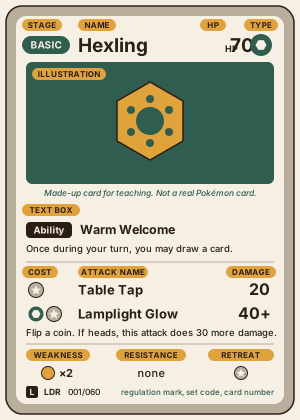
Here is an invented card, drawn for this course, with every part labeled. It follows the layout of a current Pokémon card, but the creature, the text, and the art are all made up.
The top line: what it is
Stage, top left. This card says Basic, so it can go straight into play from your hand onto the Bench, or into the Active Spot at setup. A Stage 1 or Stage 2 card is an Evolution card. Those also show, near the Stage, which Pokémon they evolve from. A Stage 1 goes on top of that Basic Pokémon; a Stage 2 goes on top of that Stage 1.
Name. The name matters for more than flavor. Your deck can hold only 4 cards with the same name, and evolving checks names exactly. An owner’s name is part of the name, so a Trainer’s Pokémon such as one named after a Gym Leader evolves only from the matching owner’s card, not the plain version.
HP, top right. Hit Points. Once the damage on this Pokémon equals or passes its HP, it is Knocked Out. Hexling has 70 HP, so 7 damage counters do it.
Type, next to HP. The type matters in two ways: which Energy its attacks usually want, and which opposing Pokémon have Weakness or Resistance to it.
The middle: what it does
Ability. Some Pokémon have an Ability, marked with its own label above the attacks. An Ability is not an attack. You can use it and still attack in the same turn, and you can use Abilities from the Bench too. Read each one closely: some you use, and some just work all the time.
Attacks. Each attack has three parts, left to right:
- Cost. The Energy symbols that must be attached to this Pokémon. A star symbol is Colorless, and any type of Energy pays for it. Table Tap needs one Energy of any type. Lamplight Glow needs one Energy of the card’s own type plus one of any type.
- Name. What you announce when you attack.
- Damage. The base damage to the opponent’s Active Pokémon. A plus sign, like 40+, means the text can add more. A times sign means the text multiplies it, and a minus sign means the text can lower it.
The text under an attack tells you anything else that happens. An attack with no damage number is still an attack.
The bottom line: what it fears
Weakness. If the attacking Pokémon’s type matches, the damage goes up by the amount shown. On current cards that is almost always ×2. Hexling takes double damage from one type.
Resistance. If the attacker’s type matches, damage goes down by the amount shown. Hexling has none.
Retreat Cost. The number of Energy you must discard from this Pokémon to swap it to the Bench. One star means one Energy of any type. No stars means it retreats for free.
Remember: Weakness and Resistance apply only to the Active Pokémon, never to Benched ones.
The very bottom: where it is from
Regulation mark. The small letter in the bottom left. Since 2020, every card carries one, and tournaments use these letters to decide which cards are legal in the Standard format. The tournaments lesson covers formats.
Set code and card number. Which expansion the card came from, and its number in that set. Handy for looking up a card or checking whether a store has a copy.
The rule box: Pokémon ex
Some Pokémon end in ex. They have more HP and stronger attacks, and a rule box on the card states the catch: when a Pokémon ex is Knocked Out, your opponent takes 2 Prize cards. A Mega Evolution Pokémon ex gives up 3. Mega Evolution Pokémon ex can be Basic, Stage 1, or Stage 2, and otherwise follow the normal rules. They evolve from whatever Pokémon the card names, not from the regular version of themselves, so read the evolves-from line. A Mega Evolution of a Stage 1 Pokémon, for example, can evolve straight from its Basic.
ACE SPEC cards are rare, powerful cards. Your whole deck can include only one ACE SPEC card in total.
Trainer and Energy cards
Trainer cards show their kind in the top left: Item, Supporter, Stadium, or Pokémon Tool. The rule for that kind sits at the bottom of the card. Do what the text says, then follow that rule.
Energy cards power attacks and pay Retreat Costs. Basic Energy is the plain kind, and it is the only kind of card your deck can hold more than 4 of.
A quick reading habit
When your opponent plays a new Pokémon, ask to see it. That is normal and polite. Then read it in this order: HP, attacks and their costs, Weakness, Retreat Cost. In five seconds you know how hard it hits, how long it lasts, and how to beat it.
Next lesson
How to Teach the Pokémon TCG in Ten Minutes
Next, the ten-minute teach: a host script for teaching the game to a kid, a friend, or a whole family, plus a printable teach sheet.
Want the course by email?
Pick the right first product, learn how a turn works, read any card, then build decks, win the Prize trade, and walk into League night, a prerelease, and a tournament ready to play. Free, one short lesson at a time.
Unofficial. Not affiliated with or endorsed by The Pokémon Company International, Nintendo, Creatures, or GAME FREAK. Pokémon is a trademark of Nintendo.