Old Yu-Gi-Oh! cards were short. A monster, a number, maybe a line of text. Modern cards carry more: a type line with three words in it, a paragraph of effect, sometimes arrows around the art or numbers on the sides. It looks like a lot. It is a lot less once you know where everything lives.
Below is an invented card built for this lesson. It is not a real card, and the art is our own.
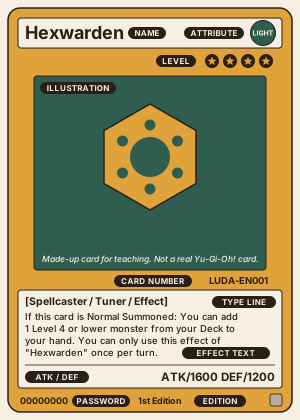
The top line: name and Attribute
Card name. Two cards with the same name are the same card, and that matters twice. You can run only 3 copies of a name across your Main, Extra, and Side Deck. And when card text mentions a name, it appears in quotation marks, like “Hexwarden.”
Attribute. The circle at the top right. The rulebook lists six: DARK, EARTH, FIRE, LIGHT, WATER, and WIND. A few god cards, such as The Winged Dragon of Ra, carry a seventh, DIVINE. Attributes do nothing on their own, but many effects care about them.
Level, Rank, and Link Rating
Level is the row of stars under the name. Level decides how many Tributes a monster needs (1 for Level 5 or 6, 2 for Level 7 or higher), and it feeds Synchro and Xyz Summons.
Rank belongs to Xyz Monsters. Their stars sit on the left side instead of the right, and Rank is not a Level. A Rank 4 Xyz Monster is built from two or more Level 4 monsters, depending on its card.
Link Rating belongs to Link Monsters, which have no Level at all. Look for red arrows around the art. Each lit arrow points to a zone, and the Link Rating equals the number of arrows. A Link Monster shows its rating where DEF would be, because it has no DEF.
The frame color tells you the card kind
You can sort a hand by color before you read a word:
- Yellow: Normal Monster, with flavor text and no effect.
- Orange: Effect Monster.
- Blue: Ritual Monster.
- Purple: Fusion Monster.
- White: Synchro Monster.
- Black: Xyz Monster.
- Dark blue with arrows: Link Monster.
- Green below the art: a Pendulum Monster, whose lower half blends into Spell green.
- Green: Spell Card. Pink: Trap Card.
Fusion, Synchro, Xyz, and Link Monsters live in your Extra Deck.
Under the art: the card number
The code just under the art on the right, like LUDA-EN001 on our mock card, is the card number. The letters name the set, “EN” marks an English card, and the digits place it in that set. It is useful for collecting and sorting, and for finding the right printing when you buy singles.
The type line
The first line of the text box, in square brackets. On our mock card it reads [Spellcaster / Tuner / Effect]:
- Spellcaster is the monster’s Type. There are many, and effects often care about them.
- Tuner is an ability. You need one Tuner for every Synchro Summon.
- Effect says it has an effect. Fusion, Synchro, Xyz, Link, Ritual, and Pendulum show up here too.
The effect text, in three parts
Modern cards follow a pattern, and the rulebook spells it out:
- Before the colon (:) is the condition or timing. “If this card is Normal Summoned:”
- Before the semicolon (;) is what you do when you activate, such as a cost or choosing a target.
- After both is what happens when the effect resolves.
Our mock card has no semicolon because it has no cost or target. Read it again with that pattern and it becomes two plain steps: when it happens, then what happens.
Watch for limits too. A line such as “You can only use this effect of “Hexwarden” once per turn” means once per turn for that name, so a second copy cannot use it again that turn.
Extra Deck monsters add one more line at the top of the text box: the materials, or “recipe,” you need to Summon them.
The rulebook sorts monster effects into four kinds:
- Continuous: always on while the card is face up.
- Ignition: you choose to activate it in your Main Phase.
- Quick: can be activated on either player’s turn. These are Spell Speed 2.
- Trigger: activates when something happens. Flip effects, marked “FLIP:”, are a kind of Trigger.
ATK and DEF
At the bottom right of the text box. ATK attacks; DEF defends while the monster is in Defense Position. Link Monsters show “LINK” and their rating instead of DEF.
Pendulum Monsters: two effects, two numbers
A Pendulum Monster’s text box is split. The top box is its Pendulum Effect, which works only while the card sits in a Pendulum Zone as a Spell. The numbers on either side of that box are its Pendulum Scale. The lower box is its normal monster effect. Either box can be empty.
The bottom edge
- Password: the 8-digit number at the bottom left. It does nothing in the game.
- Edition: “1st Edition” marks the first print run of a set. Later printings may carry no edition mark. Both are legal to play.
Spell and Trap Cards
Spells and Traps have no Attribute, Level, or ATK. Instead, the type line names the card kind, and an icon shows its sub-type. There are six icons: Equip, Field, Quick-Play, Ritual, Continuous, and Counter. No icon means a Normal Spell or Normal Trap.
When you meet a card you do not know, look it up in Konami’s official card database. The printed text on older cards may not match how the card works today.
Next lesson
How to Teach Yu-Gi-Oh! in Ten Minutes
Next, teaching it in ten minutes. A host script for a returning player teaching a brand new one, in the order you would say it.
Want the course by email?
Come back to Yu-Gi-Oh! after years away, catch up on Link and Pendulum Summoning and the modern pace, and walk into an Official Tournament Store ready to duel. Free, one short lesson at a time.
Unofficial. Not affiliated with or endorsed by Konami. Yu-Gi-Oh! is a trademark of Konami or its licensors.