If you learned Yu-Gi-Oh! years ago, most of this lesson will feel like a reunion. The new parts are mostly about the Extra Deck. This lesson follows Konami’s Official Rulebook, Version 10, as changed by the 2021 Rules Update.
How do you win?
Each player starts with 8000 Life Points (LP). You win a Duel when:
- Your opponent’s LP hits 0.
- Your opponent has to draw a card and cannot.
- A card’s effect says you win.
If both players hit 0 at the same time, the Duel is a draw. At events, Duels come in best-of-three Matches.
The field
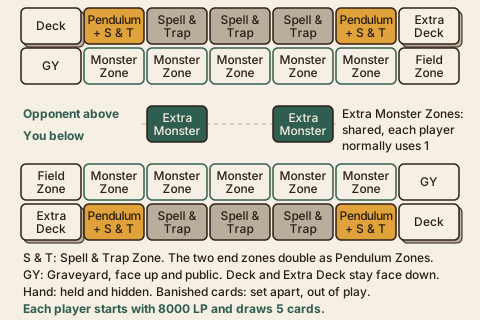
- Main Monster Zones. Five zones for your monsters. Upright is Attack Position; sideways is Defense Position.
- Spell & Trap Zones. Five zones behind them. Your leftmost and rightmost zones also act as Pendulum Zones when you place a Pendulum Monster there as a Spell.
- Field Zone. One Field Spell at a time, and it does not count against your five Spell & Trap Zones.
- Graveyard (GY). Face up and public. Your opponent may look through it, but should ask first and keep the order.
- Deck and Extra Deck. Both face down. You may look at your own Extra Deck during the game.
- Extra Monster Zones. Two zones in the middle of the field, between the players. Each player can normally use only one.
- Banished cards are set apart from the field, out of play.
How do you set up?
- Each player needs a Main Deck of 40 to 60 cards, plus an Extra Deck of up to 15. No more than 3 copies of a card across Main, Extra, and Side Deck together.
- Shuffle your Deck. You may shuffle or cut your opponent’s.
- Rock-paper-scissors or a coin flip. The winner picks first or second. In later Duels of a Match, the loser of the last Duel picks.
- Each player draws 5 cards.
The six phases
Draw Phase. Draw 1 card. The player who goes first skips this draw on their first turn.
Standby Phase. Resolve any card that acts “during the Standby Phase.”
Main Phase 1. Most of the game happens here:
- Normal Summon or Set one monster from your hand, once per turn. A monster Set face down is not Summoned.
- Tribute for big monsters: Level 5 or 6 needs 1 Tribute, Level 7 or higher needs 2. A Tribute Summon is your Normal Summon for the turn.
- Flip Summon a face-down monster to face-up Attack Position, but not the turn you Set it.
- Special Summon as often as your cards allow. This is where modern decks do their work.
- Change battle positions, once per monster per turn, but not on a monster that arrived this turn, or in Main Phase 2 on one that attacked.
- Activate and Set Spells and Traps.
Battle Phase. Each face-up Attack Position monster may attack once. The first player cannot conduct a Battle Phase on their first turn.
Main Phase 2. The same actions as Main Phase 1, minus anything you already used up, like your Normal Summon.
End Phase. Resolve End Phase effects, then discard down to 6 cards in hand.
The Extra Deck and where monsters land
Ritual Monsters live in your Main Deck and are Summoned with a Ritual Spell plus Tributes. Five more kinds of monster have their own Summons, and the Extra Deck is where most of them wait:
| Monster | How you Summon it |
|---|---|
| Fusion | A card like Polymerization sends the listed materials to the GY |
| Synchro | 1 face-up Tuner plus face-up non-Tuners whose Levels add up exactly |
| Xyz | Face-up monsters of the same Level, stacked under it as materials |
| Link | Face-up monsters equal to its Link Rating, matching its recipe |
| Pendulum | Two Pendulum Scales set; Summon monsters with Levels between them |
Now the rule that matters most. Under the 2021 Rules Update:
- Fusion, Synchro, and Xyz Monsters Summoned from the Extra Deck can go into any of your Main Monster Zones, or your Extra Monster Zone if you prefer.
- Link Monsters, and face-up Pendulum Monsters Summoned from the Extra Deck, must go into your Extra Monster Zone or a Main Monster Zone that a Link Monster’s arrow points to.
Link Monsters are the key: every zone a Link Arrow points to becomes a place for more of them to land. That is how modern decks fill a board in one turn.
Two more Link facts: Link Monsters have no DEF and can never be in Defense Position. A monster in an Extra Monster Zone still counts as one of your monsters, so your opponent cannot attack you directly past it.
Pendulum in brief
A Pendulum Monster can be Summoned like a normal monster, or placed in a Pendulum Zone as a Spell. Once you have one in each Pendulum Zone, once per turn you may Pendulum Summon any number of monsters from your hand, plus face-up Pendulum Monsters from your Extra Deck, whose Levels sit between the two Scales. When a Pendulum Monster on the field would go to the GY, it goes face up onto your Extra Deck instead, ready to come back.
Battle math
| You attack | Result |
|---|---|
| Attack Position, your ATK higher | Destroy it; they take the difference |
| Attack Position, ATK equal | Both destroyed; no damage |
| Attack Position, your ATK lower | Your monster is destroyed; you take the difference |
| Defense Position, your ATK higher | Destroy it; no damage |
| Defense Position, ATK equal to DEF | Nothing is destroyed; no damage |
| Defense Position, your ATK lower | Nothing is destroyed; you take the difference |
| No monsters on their side | Direct attack for your full ATK |
Chains and Spell Speed
When a card or effect is activated, your opponent always gets a chance to respond. Responses stack up as a Chain and resolve in reverse order, last one first.
- Spell Speed 1: most Spells and most monster effects. Cannot respond to anything.
- Spell Speed 2: Traps, Quick-Play Spells, and Quick Effects. Can respond to Speed 1 or 2.
- Spell Speed 3: Counter Traps. Can respond to anything.
Traps must be Set first and cannot be activated the turn you Set them. Quick-Play Spells can be played from your hand during any phase of your own turn, or Set to use on your opponent’s turn, just not the turn you Set them.
When a card’s text conflicts with these rules, the card wins.
Next lesson
How to Read a Yu-Gi-Oh! Card: Every Part, Labeled
Next, reading a card. We label every part of a modern Yu-Gi-Oh! card on an original mock card, from Attribute and Level to Link Arrows and the password.
Want the course by email?
Come back to Yu-Gi-Oh! after years away, catch up on Link and Pendulum Summoning and the modern pace, and walk into an Official Tournament Store ready to duel. Free, one short lesson at a time.
Unofficial. Not affiliated with or endorsed by Konami. Yu-Gi-Oh! is a trademark of Konami or its licensors.